Key takeaways
- Licensing requirements, capital, fees and approval timelines vary significantly across jurisdictions.
- Of 379 MiCA-authorised providers, only 143 passport their licences across the entire EEA.
- In the US, 34 digital asset companies have applied for national charters with the OCC.
- A new entrant in Brazil should expect licensing to take around two years, according to local practitioners.
- The UK's application window for its new crypto regime closes on 28 February 2027.
Expanding a stablecoin business into a new country brings a familiar set of questions. Which regulator do you approach? What licence do you need? How much capital must you set aside? And how long will approval take?
The answers can be surprisingly different, even between countries with similar regulatory frameworks.
In Brazil, for instance, a new entrant may need around USD 2 million to 3 million in minimum capital and should prepare for a licensing process lasting roughly two years. El Salvador, by contrast, has no statutory minimum capital requirement for digital asset service providers.
Differences also exist within the European Economic Area (EEA), where the Markets in Crypto-Assets Regulation (MiCA) provides a common regulatory framework. Of the 379 MiCA-authorised providers covered in our research, 143 passport their licences across all 29 other EEA countries, while 151 operate only in their home jurisdiction.
These are some of the findings from The State of Global Stablecoin Licensing, published by Anvesan Research on 2 November 2026.
The report examines the regulatory landscape in 12 countries, covering the licences required for different stablecoin activities, the cost of obtaining them, local operational requirements and the practical challenges companies face during licensing.
This article brings together the main findings from each country. For the complete service-by-service breakdown, supporting references and practitioner insights, you can download the full report.
How we conducted the research
The report combines regulatory research with insights from people who work directly with licensing authorities.
Our team reviewed legislation, regulations, official guidance and publications from the relevant regulators in each country. We also consulted law firms and regulatory advisers through the Anvesan Legal Network, as well as compliance professionals at companies that have been through licensing themselves.
Before publication, factual claims were checked against legislation, official publications, public registers or published reporting. Contributors to individual country sections are credited in the report.
There is an important distinction between the figures presented throughout this article.
Regulatory requirements, such as minimum capital and government application fees, are established by law or regulation. Estimated costs and timelines, including legal fees and the time a company should realistically budget for approval, come primarily from interviews with practitioners.
Those estimates will vary depending on the company's activities, structure, preparation and the regulator involved.
The report reflects regulatory information available as of 25 October 2026, with register data updated through 31 October 2026. It is intended as a starting point for regulatory planning, not as legal advice.
What the licensing registers tell us
Before examining individual countries, the report looks at how the global licensing landscape is developing.
Using data from Anvesan Atlas, we examined official registers to understand how quickly firms are entering regulated markets.
In the EU and EEA, 229 providers joined the MiCA register between January and 31 October 2026, compared with 145 during 2025.
June 2026 was particularly active, with 75 new entries. That was the final month before the MiCA transition period ended on 1 July 2026.
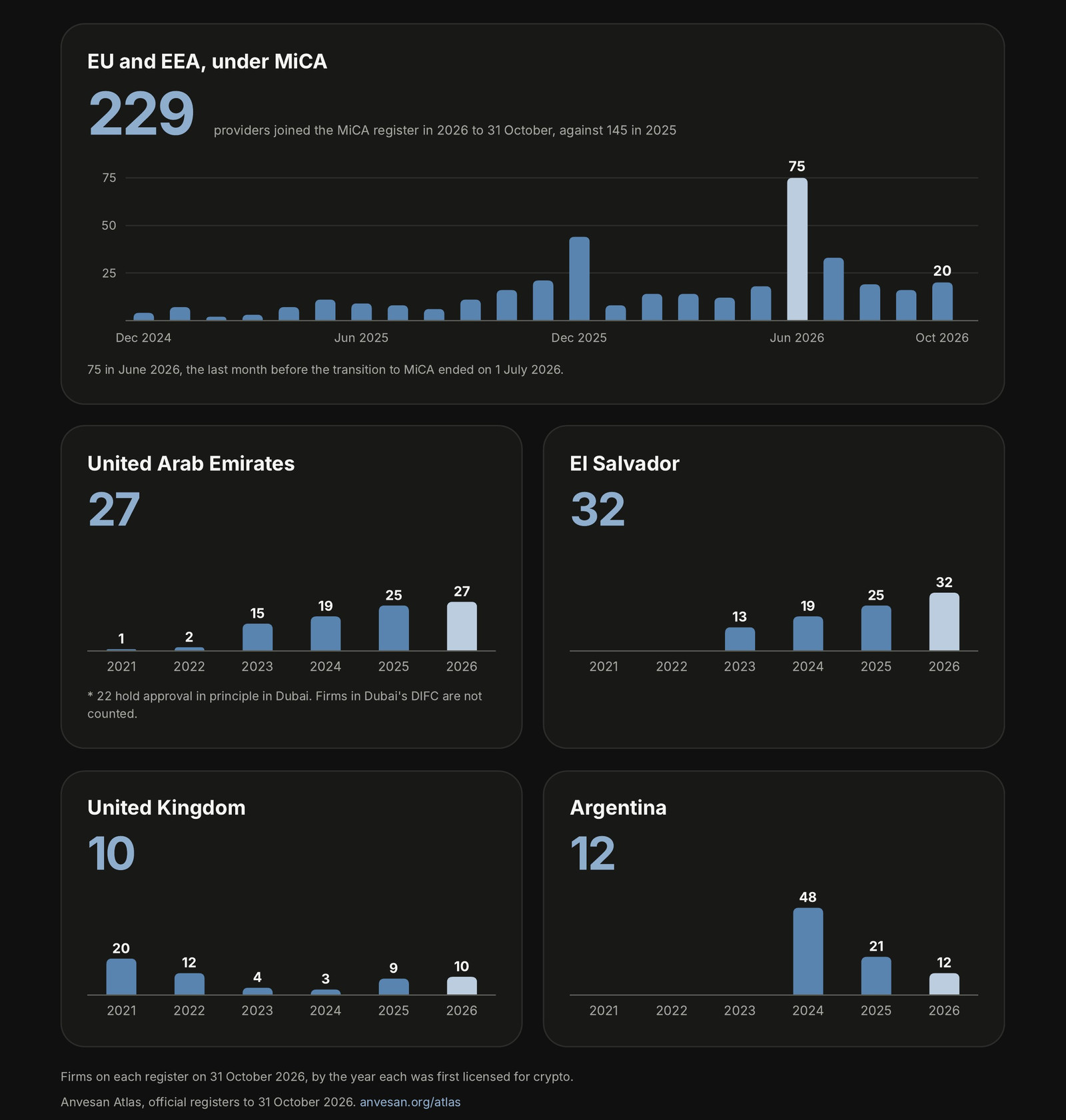
We also examined four other markets, grouping companies by the year they first received a crypto licence.
The UAE recorded 27 firms first licensed in 2026. The report notes that 22 held approval in principle in Dubai, while firms regulated in the Dubai International Financial Centre (DIFC) were excluded from the count.
El Salvador recorded 32 firms first licensed in 2026.
The UK's largest year was 2021, with 20 firms, while Argentina saw its highest number in 2024, when 48 firms were first licensed.
These figures count only companies that remained on the relevant registers on 31 October 2026. They therefore exclude firms whose registrations had ended, and the 2026 figures cover only the first ten months of the year.
MiCA: One licence, different realities
One of MiCA's main advantages is passporting.
A company authorised under MiCA in one EEA country can provide its authorised services across all 30 EEA countries without applying for a separate MiCA licence in each one.
The EEA includes the EU's 27 member states, along with Iceland, Liechtenstein and Norway.
To passport its licence, a company notifies its home regulator of the countries it intends to enter, the services it plans to offer and its proposed start date.
The company can begin once the regulator confirms that it has forwarded the notification, or 15 calendar days after filing, whichever happens first.
For businesses that also require payment or e-money licences, those authorisations can be passported too. The process is separate, however, and may take up to three months.
How widely are companies using passporting?
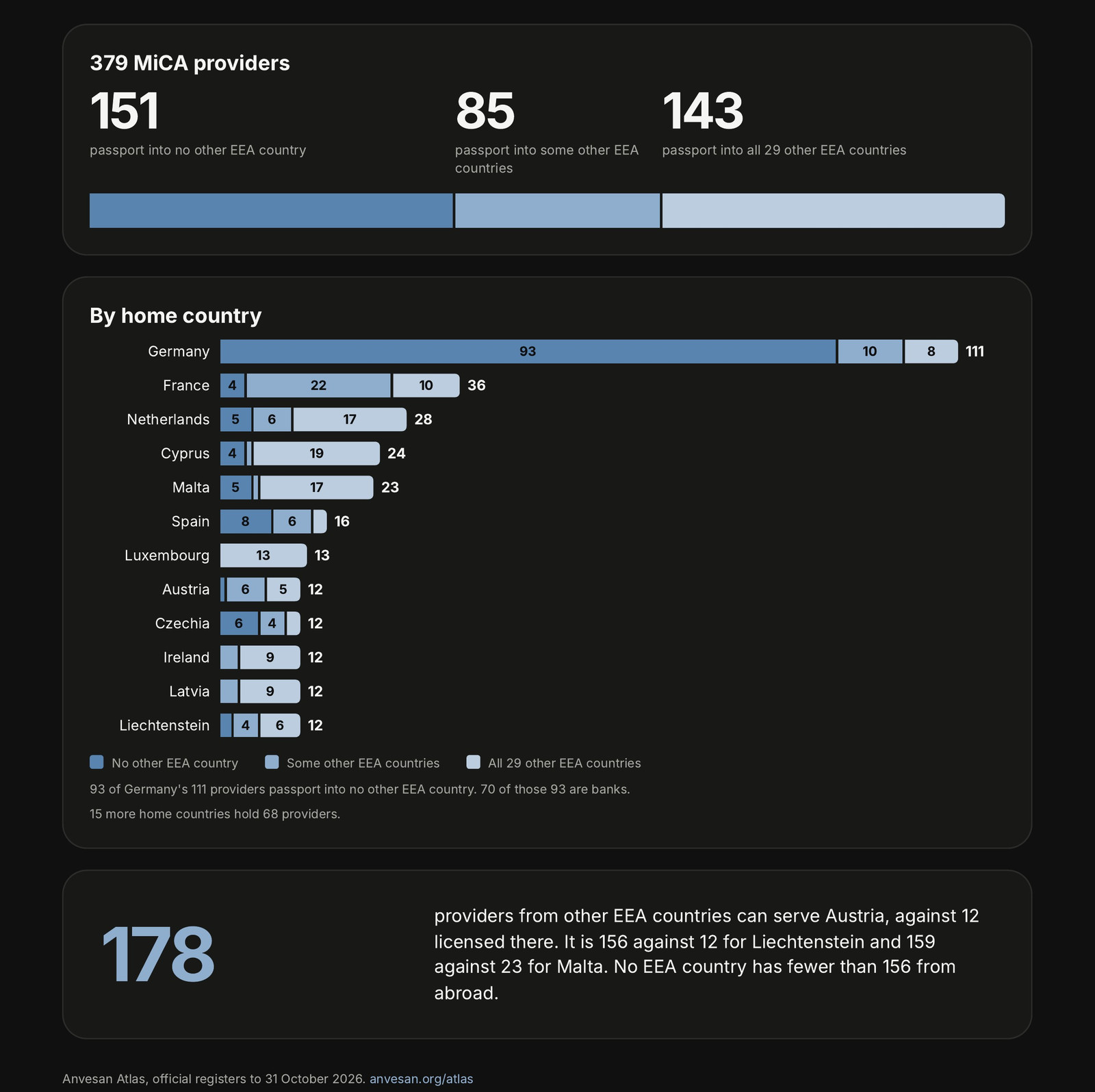
Our analysis of 379 MiCA-authorised providers shows a striking difference in how companies use this opportunity.
Only 143 providers have passported into all 29 other EEA countries. The largest group, 151 providers, have not passported into any additional EEA market.
Germany has the largest number of home-licensed providers, at 111. Of these, 93 have not passported elsewhere, including 70 banks.
Passporting also changes the competitive landscape in smaller markets.
Austria has 12 locally licensed providers, but another 178 providers authorised elsewhere in the EEA can serve customers there. Liechtenstein has 12 domestic providers and 156 passported-in providers. Malta has 23 domestic providers and 159 from other EEA countries.
Every EEA country has at least 156 providers authorised elsewhere that can serve its market.
The rules may be common across Europe, but the experience of obtaining a licence is not. Regulatory expectations, staffing requirements, fees and approval timelines differ considerably.
To illustrate these differences, the report examines Austria, Liechtenstein and Malta in detail.
United States: 34 firms pursuing federal charters
A separate analysis looks at digital asset companies pursuing national charters from the Office of the Comptroller of the Currency (OCC).
As of the report's cut-off, 34 companies had applied for national charters to operate digital asset or stablecoin businesses. Our count includes applications listed on the OCC's digital asset index, along with other trust charter filings from crypto and stablecoin companies.
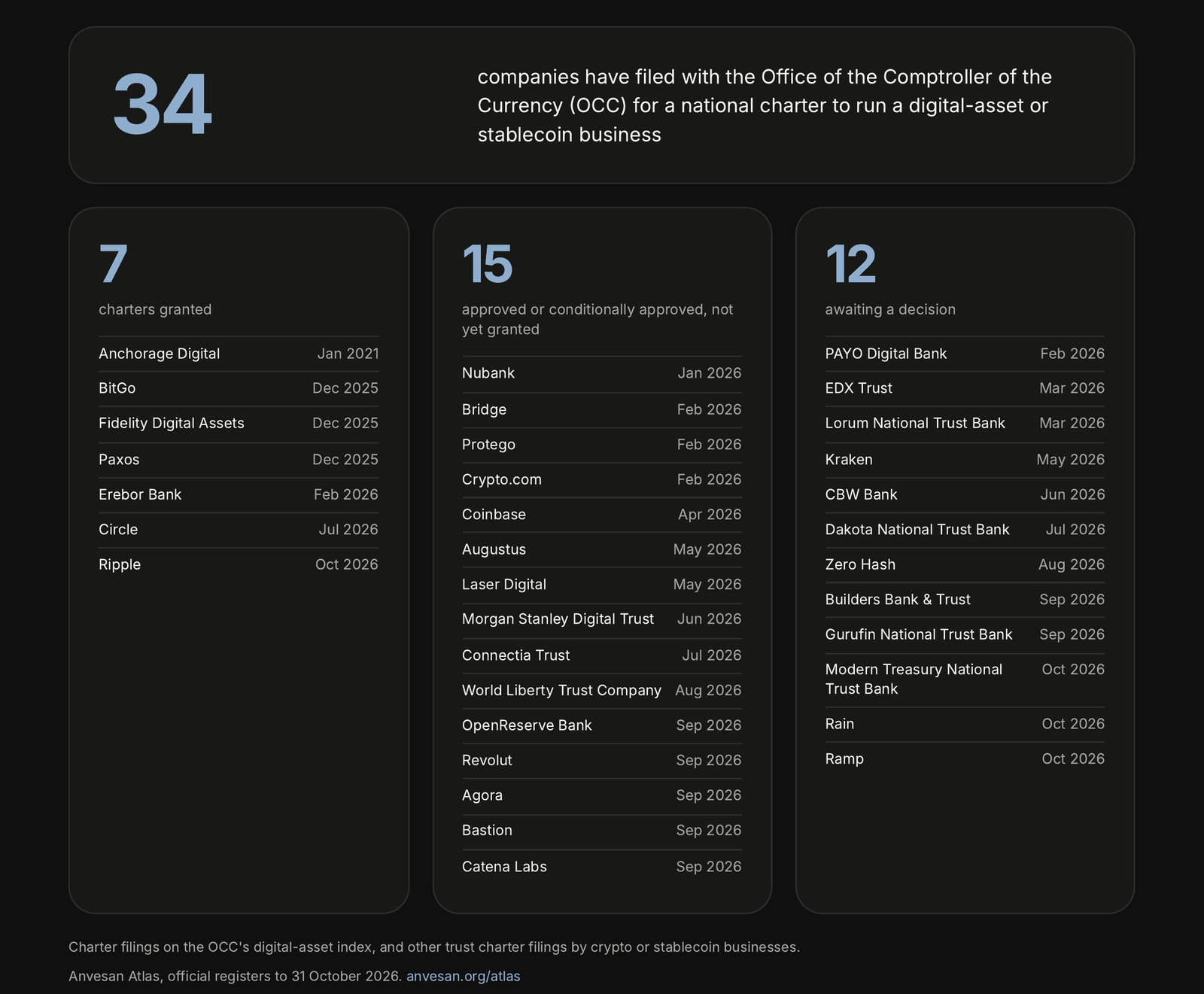
Seven had received their charters: Anchorage Digital, BitGo, Fidelity Digital Assets, Paxos, Erebor Bank, Circle and Ripple.
Another 15 had received approval or conditional approval but had not yet been granted their charters. These included Nubank, Bridge, Crypto.com, Coinbase, Morgan Stanley Digital Trust and Revolut.
The remaining 12 were awaiting decisions, including Kraken, Zero Hash, Rain and Ramp.
Country-by-country licensing requirements
Austria: Why a MiCA licence may not be enough
Austria operates under MiCA, with the Financial Market Authority (FMA) responsible for licensing.
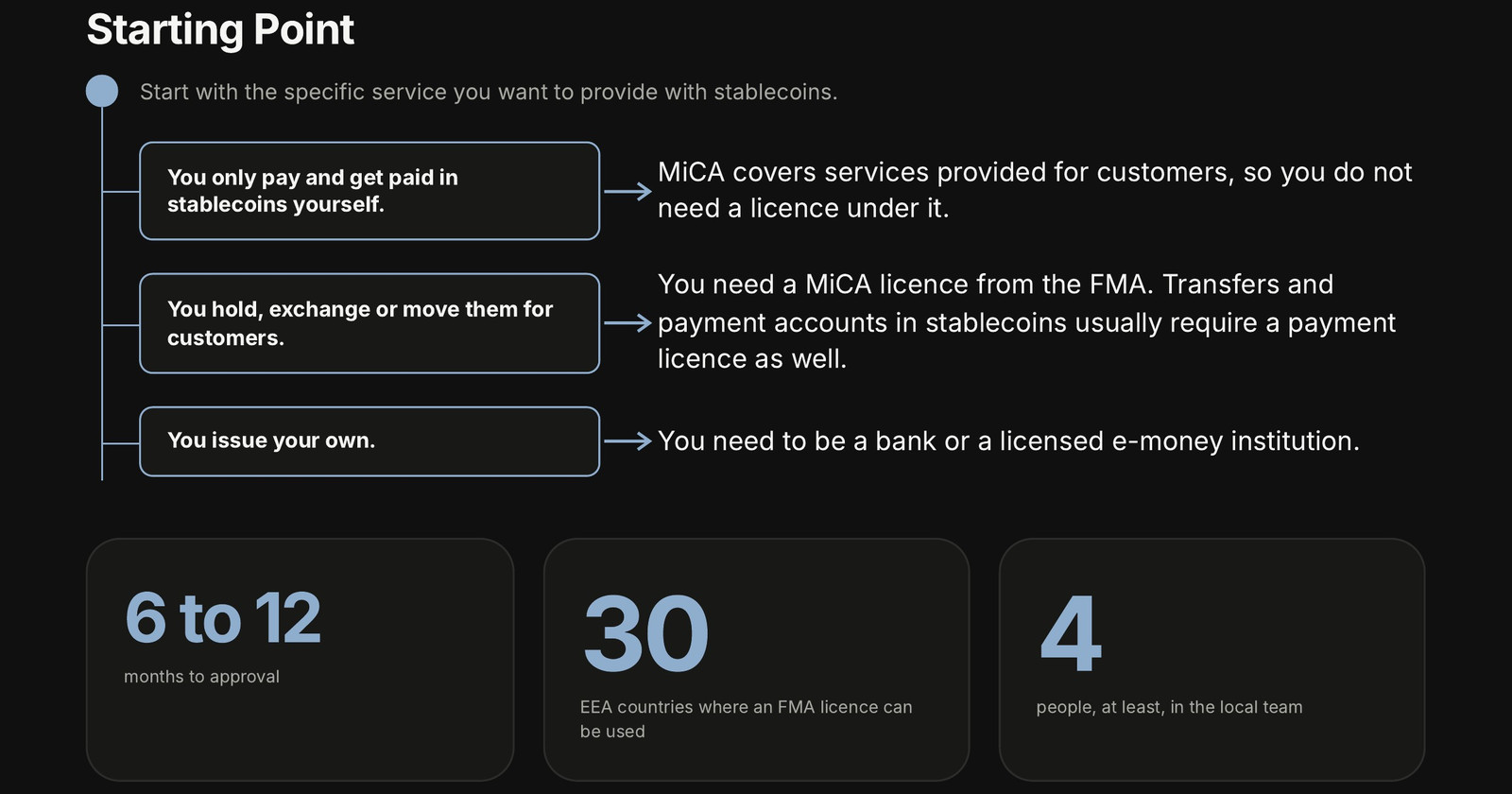
For a company planning to establish operations there, the report estimates 10 to 12 months for approval and around EUR 5 million to establish and operate the business over its first three years. Staffing accounts for most of that cost.
The licence a company needs depends on what it actually does with stablecoins.
Simply paying or receiving payments in stablecoins for one's own business does not require a MiCA licence. MiCA regulates services provided to customers.
Holding, exchanging or transferring stablecoins on behalf of customers, however, requires MiCA authorisation and, in most cases, a separate payment institution licence.
Companies issuing their own stablecoins must operate as a bank or licensed e-money institution.
The second-licence problem
One of the most common mistakes is assuming that MiCA authorisation covers every stablecoin-related activity.
Under EU banking guidance, transferring stablecoins for customers, including through wallets that send and receive them, can qualify as a payment service.
That means a company may need both a MiCA licence and a payment institution licence, unless it works with an already licensed payment provider. Exchange services alone do not trigger the additional payment licence requirement.
The European Parliament's anticipated vote on the Payment Services Regulation on 14 December 2026 could change how these requirements interact.
Capital, fees and staffing
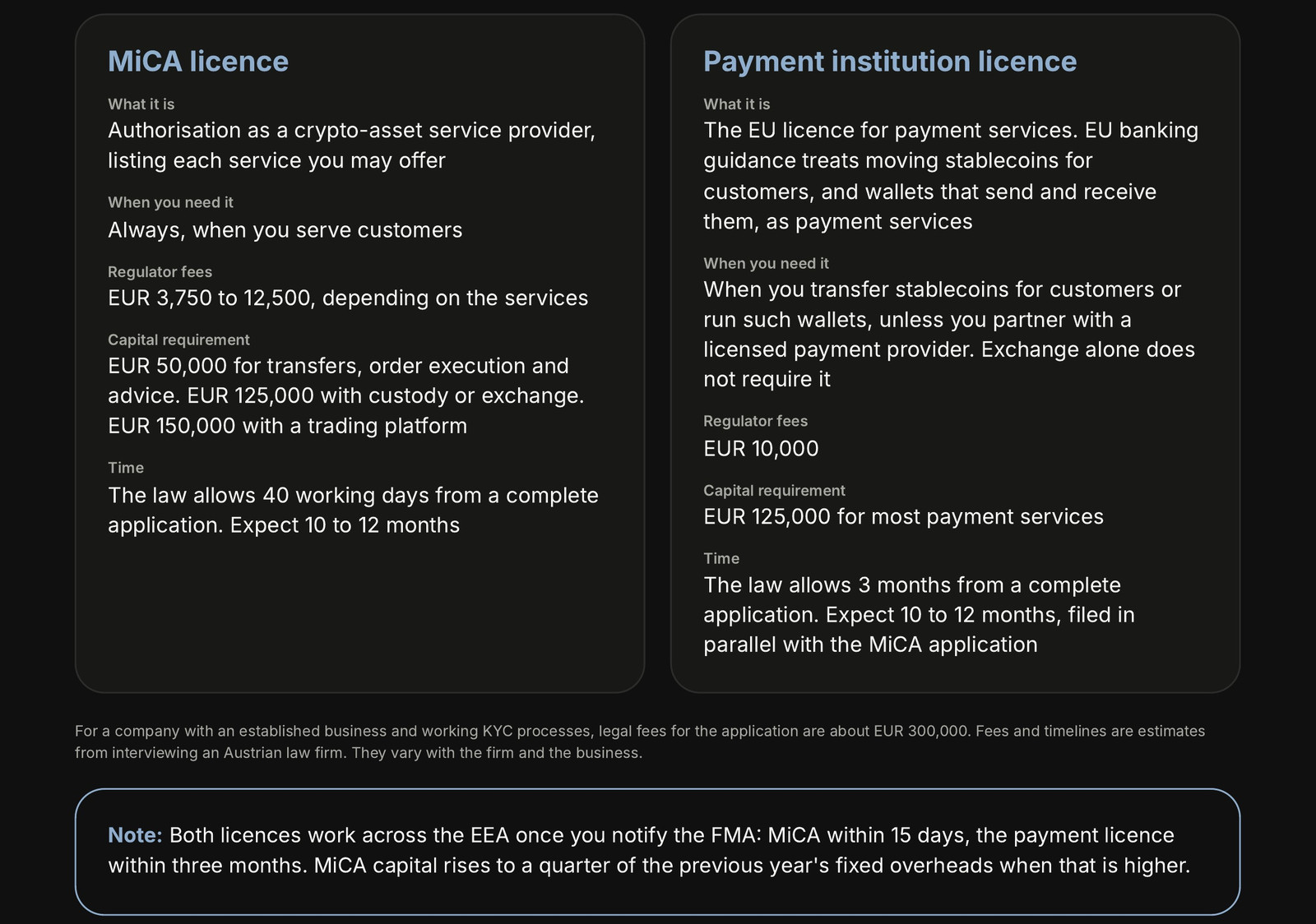
MiCA minimum capital starts at EUR 50,000 for services such as transfers, order execution and advice, rising to EUR 150,000 for businesses operating a trading platform. Where a quarter of the previous year's fixed overheads is higher, that amount applies instead.
FMA application fees range from EUR 3,750 to EUR 12,500.
Although the statutory decision period is 40 working days from a complete MiCA application, and three months for a payment licence, Austrian practitioners advise allowing 10 to 12 months for the overall process.
One Austrian law firm estimated legal fees of around EUR 300,000 for an established business with functioning KYC procedures.
The larger expense is maintaining the local operation.
A company should plan for at least five dedicated staff members, including a managing director, an anti-money-laundering reporting officer and deputy, a person responsible for operational resilience under DORA, and a chief information security officer.
Compliance continues to matter after approval. In August 2026, the FMA fined a licensed provider EUR 70,000 for violations that included marketing a token before publishing its white paper.
Companies seeking an e-money institution licence need at least EUR 350,000 in initial capital.
As of September 2026, Austria had no registered stablecoin issuers.
Liechtenstein: A gateway to the EEA, with real local presence required
Liechtenstein is not an EU member, but its membership of the EEA makes it part of the MiCA framework.
A MiCA licence issued by Liechtenstein's Financial Market Authority (FMA) can therefore be passported throughout the EEA.
This makes the country particularly attractive to businesses based in Switzerland that want access to the European market.
Liechtenstein also has experience regulating blockchain businesses. Its Token- und VT-Dienstleister-Gesetz (TVTG), introduced in 2020, gave the country a dedicated legal framework years before MiCA took effect.
Two local law firms interviewed for the report estimated a licensing timeline of six to twelve months.
The minimum local team is four people, although firms typically employ between four and nine. Businesses offering stablecoin transfers or payment accounts will usually need a payment licence alongside MiCA authorisation.
Local substance is important
Liechtenstein expects more than a registered office.
Management must be based in the country, and employees should be able to reach the office daily.
That does not necessarily mean everyone must live in Liechtenstein. Liechtenstein's immigration rules are strict.
In practice, the FMA expects relevant personnel to live within approximately 100 kilometres of Vaduz, an area that includes Zurich and Munich.
Finding experienced people who can meet these expectations is one of the challenges identified by local advisers.
The order of the licensing process matters too.
Before a formal application, the FMA generally expects to meet the proposed team and discuss the business. A local law firm will typically arrange this meeting once the applicant has developed its business plan.
Companies previously registered under the TVTG had until 1 July 2026 to transition to MiCA where required. The TVTG remains relevant to token ownership and transfers, as well as activities outside MiCA's scope, particularly NFTs.
Stablecoin issuers must notify the FMA at least 40 working days before an offering and publish a white paper.
No stablecoin had been issued from Liechtenstein as of the report's cut-off.
Malta: An established licensing centre adjusting to MiCA
Malta began licensing crypto businesses in 2018, making it one of Europe's earliest regulated digital asset markets.
Today, licensing falls under MiCA and is administered by the Malta Financial Services Authority (MFSA).
A Maltese advisory firm interviewed for the report estimated that obtaining authorisation and running a business for its first year would cost approximately EUR 300,000 to EUR 400,000.
What does the process involve?
Companies begin by submitting a statement of intent to the MFSA.
The statutory decision period is 40 working days for a complete MiCA application and three months for a payment institution licence.
MiCA application fees range from EUR 10,000 to EUR 25,000, depending on the activities requested.
Annual fees range from EUR 10,000 to EUR 50,000, with an additional EUR 2,000 per authorised service and a charge based on transaction volume.
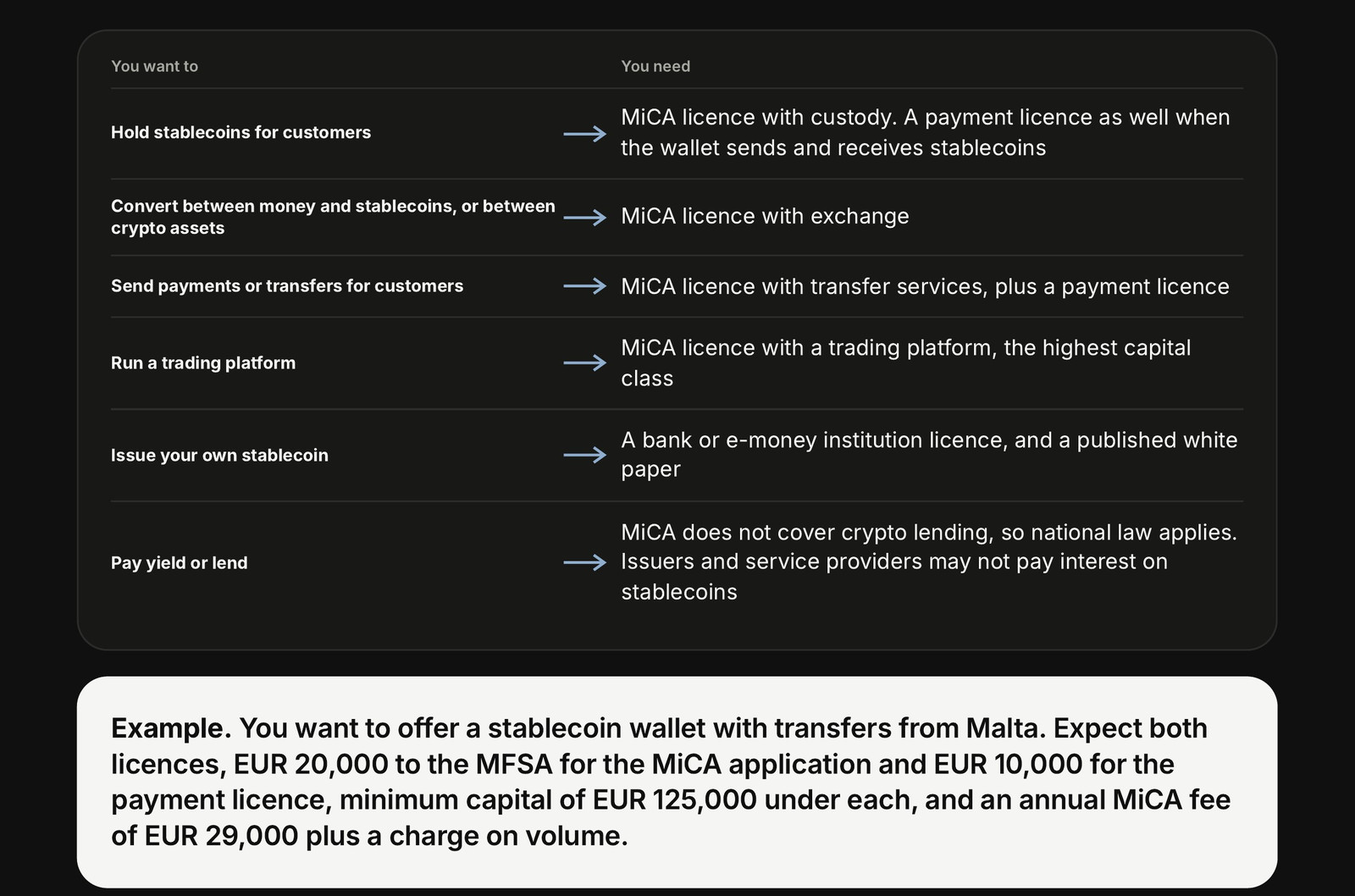
Consider a company offering a stablecoin wallet with transfer functionality.
The report's worked example assumes the business needs both MiCA and payment institution authorisation.
That would mean EUR 20,000 in MiCA application fees, EUR 10,000 for the payment institution application and minimum capital of EUR 125,000 under each licence.
The annual MiCA fee would be EUR 29,000, plus a volume-based charge.
Management and compliance
Malta requires at least two people to direct a licensed business, including an executive director based in the country.
For a payment institution, two people must direct the business from Malta.
Companies must also appoint a money-laundering reporting officer and a compliance officer approved by the MFSA. One person may perform both functions. An internal audit function is also necessary.
Malta's transition from its earlier crypto licensing regime ended on 1 July 2026. Firms without MiCA authorisation are expected by the European Securities and Markets Authority (ESMA) to wind down their EU operations.
The Maltese adviser interviewed for the report emphasised two factors that can make or break an application: the applicant's previous experience operating a regulated business and how precisely it defines the services for which it seeks authorisation.
As of October 2026, Malta had two registered stablecoin issuers: StablR and Stable Mint.
Ukraine: A large crypto market without a functioning licensing regime
Ukraine has significant crypto activity, but companies still cannot obtain a domestic licence specifically for crypto or stablecoin services.
The country adopted a virtual assets law in 2022, but it never came into force.
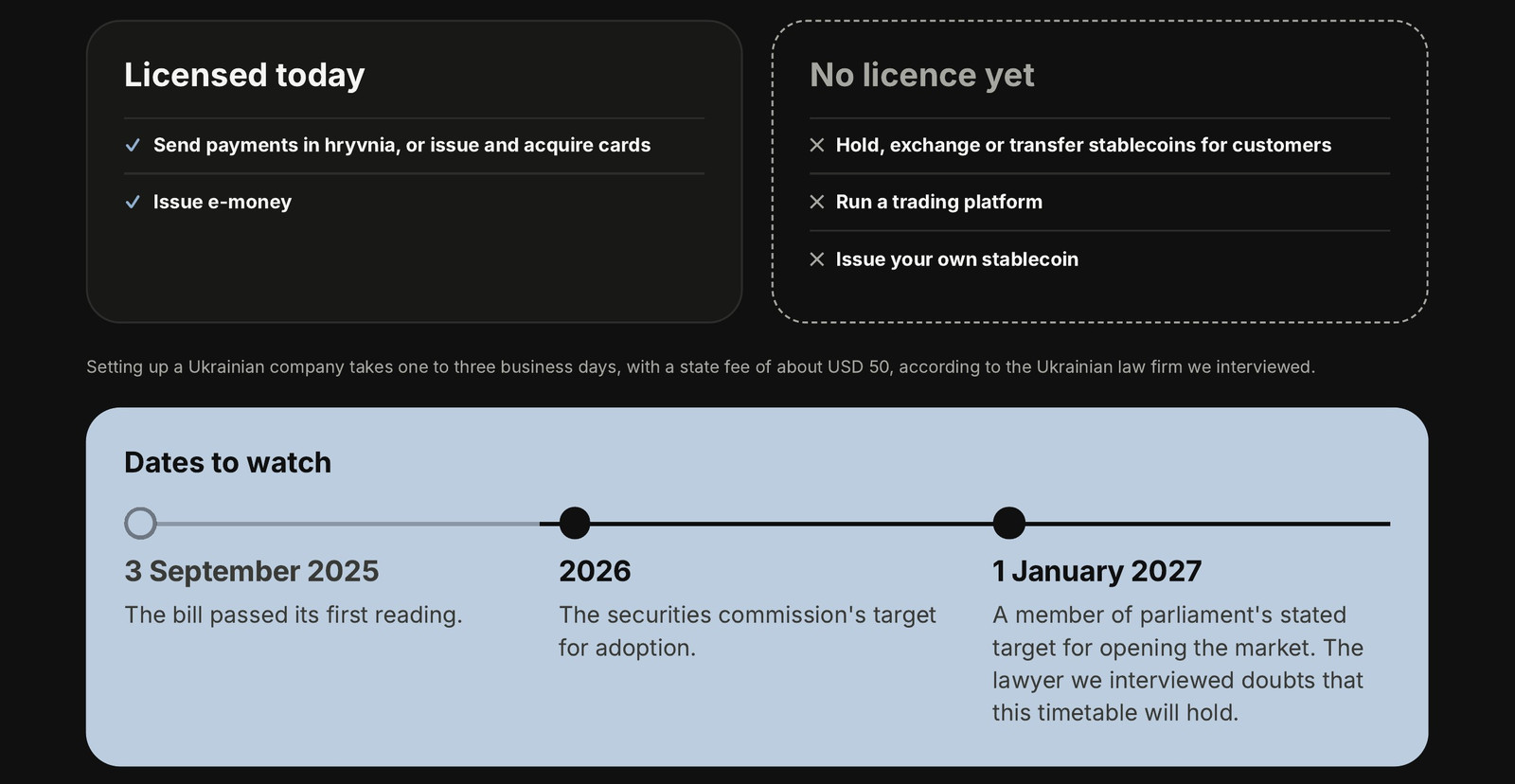
A replacement bill modelled on MiCA passed its first parliamentary reading on 3 September 2025. As of the report's cut-off, it was awaiting a second reading.
Despite this regulatory gap, Ukraine remains an active market. One 2026 global adoption index ranked it seventh in the world.
What can companies do today?
There is no operational licensing route for stablecoin service providers.
Businesses commonly serve Ukrainian customers through entities registered elsewhere.
Holding, exchanging and transferring crypto assets for Ukrainian customers are not expressly prohibited, but they operate without a dedicated legal framework.
One Ukrainian lawyer interviewed for the report noted that a Ukrainian company cannot legally receive stablecoins into its accounts or convert them into dollars.
Traditional payment services are regulated separately.
The National Bank of Ukraine licenses payment institutions and e-money institutions, but neither authorisation covers crypto assets.
Both carry a government application fee of UAH 310,600. The statutory review period is 60 working days, extendable by another 30.
Minimum capital ranges from UAH 1 million for money transfers without an account to UAH 10 million for e-money issuance.
When might the rules change?
The securities regulator has targeted 2026 for adoption of the new legislation.
A member of parliament suggested 1 January 2027 as a target date for opening the regulated market, although the lawyer interviewed for the report expressed doubts about whether this would be achievable.
Under the proposed framework, currency-pegged stablecoins would fall under the National Bank's supervision.
Until the legislation is adopted and implemented, companies planning to enter Ukraine face considerable regulatory uncertainty.
Argentina: New crypto rules took effect in October 2026
Argentina regulates crypto businesses through its securities regulator, the Comisión Nacional de Valores (CNV).
Companies that exchange, transfer or hold crypto assets for customers, including stablecoins, must register as virtual asset service providers, known locally as PSAVs.
The framework changed shortly before our report was published.
On 14 October 2026, the CNV issued revised rules for PSAVs, which took effect two days later.
Stablecoins do not require a separate licence. Banks, meanwhile, remain prohibited from offering crypto services to customers.
Stablecoins play a particularly important role in Argentina's crypto market. An August 2026 analysis found that they accounted for 94% of crypto trading volume denominated in pesos.
Registration requirements
Argentina has five PSAV categories, each with its own requirements.
Minimum net worth is USD 150,000 for exchange or custody services and USD 75,000 for transfers.
These amounts are halved for businesses below USD 2.5 million in annual transaction volume or assets under custody, as applicable.
Services connected to an issuer's token offering require USD 35,000.
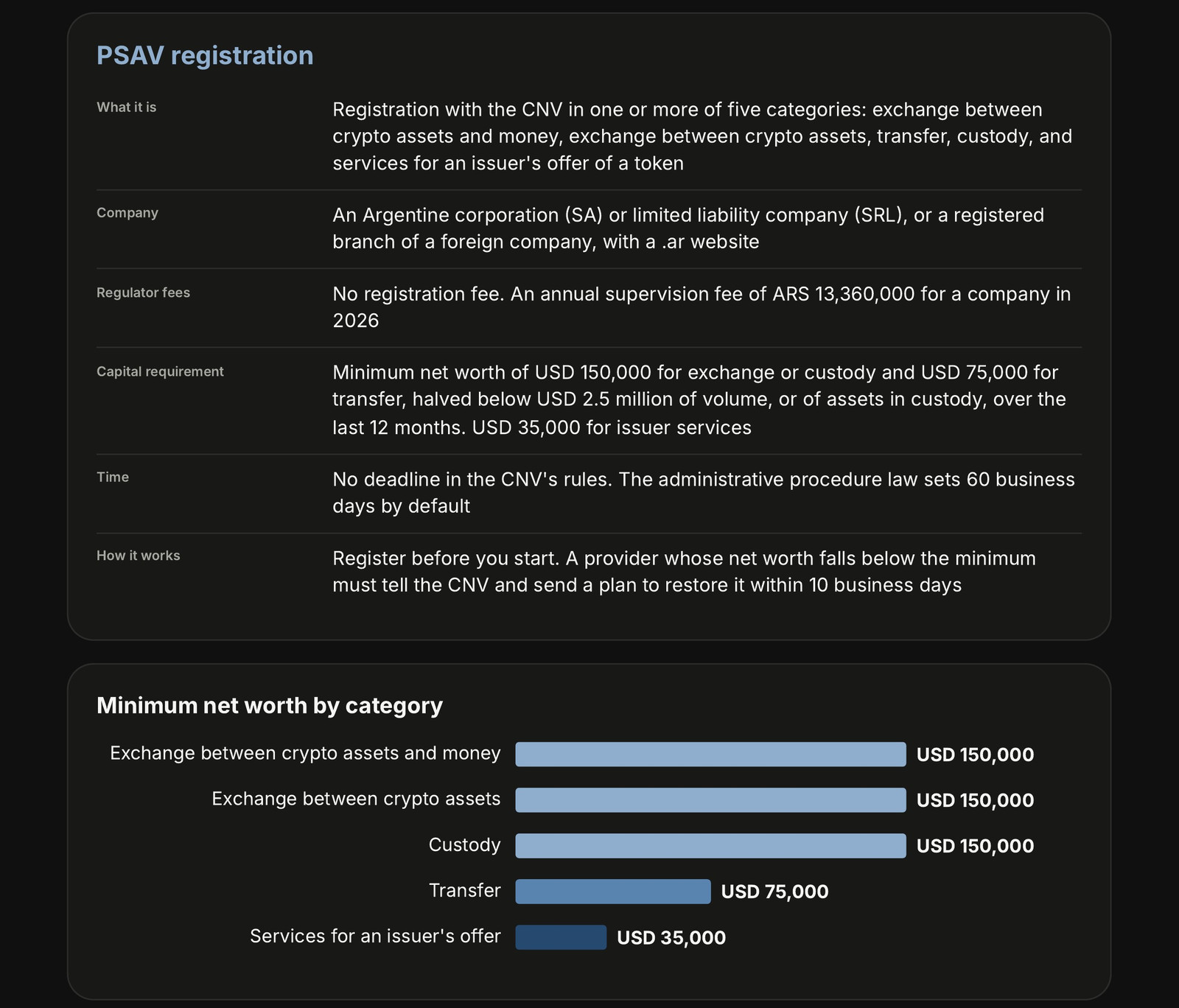
There is no registration fee. The annual regulatory supervision fee for a company is ARS 13,360,000 in 2026.
The CNV has not set a specific decision deadline under its PSAV rules. Argentina's general administrative procedure law provides a default period of 60 business days.
Foreign companies are not automatically exempt
A business can fall under Argentina's rules even without a local office.
Using a .ar website, arranging to receive money from Argentine residents or marketing directly to customers in Argentina can trigger registration requirements.
Foreign businesses must register through an Argentine company or a locally registered branch.
Token issuance itself is not classified as a PSAV activity. However, a stablecoin promising returns to holders may be treated as a security.
In March 2026, the CNV ordered Belo and Twin Finance to stop offering ARGt, a peso stablecoin advertised with a guaranteed return. The order was lifted in April after the companies removed references to returns.
Registered providers must appoint people responsible for regulatory compliance, internal control and relations with the public. Their systems must also undergo annual audits.
In October 2026, reports indicated that Argentina's central bank intended to maintain its prohibition on banks offering crypto services until 2028.
Brazil: Significant capital requirements and a long approval process
Brazil's new licensing regime for crypto service providers came into force on 2 February 2026.
The Central Bank of Brazil now authorises companies that hold, exchange or transfer stablecoins and other virtual assets on behalf of customers.
Banks and brokers that already hold Central Bank authorisation follow a simpler notification process.
The rules also treat a provider's buying, selling or exchanging of stablecoins with its customers as a foreign exchange operation, settled in Brazilian reais.
Existing businesses have an advantage
Companies already operating in Brazil had until 30 October 2026 to submit their applications.
Those that filed on time can continue operating while the Central Bank reviews their applications.
New entrants, however, must receive authorisation before starting business.
This difference has encouraged some foreign companies to consider acquiring existing Brazilian providers rather than applying from scratch.
Capital and cost
Brazil's minimum capital requirements are among the highest covered in the report.
The requirements are calculated using a regulatory formula and must be met with cash capital.
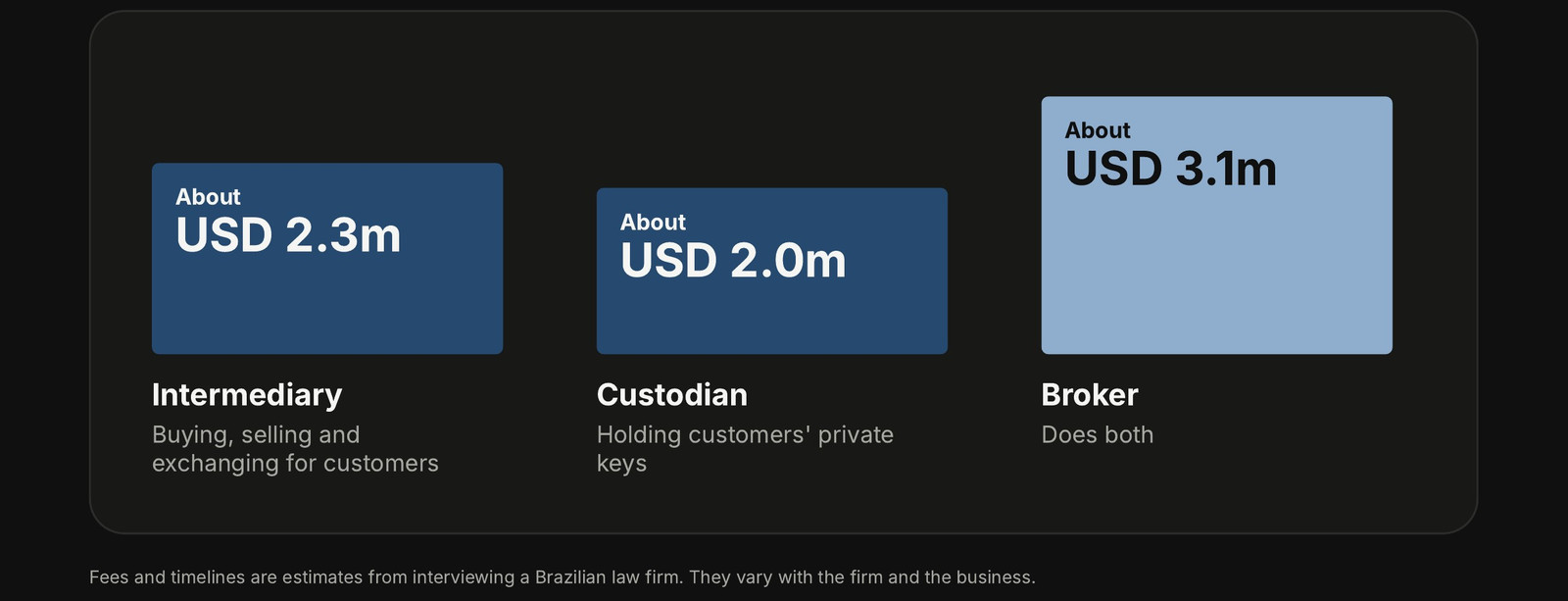
| Provider category | Approximate minimum capital |
|---|---|
| Intermediary | BRL 12.4 million (USD 2.3 million) |
| Custodian | BRL 10.8 million (USD 2.0 million) |
| Broker | BRL 16.8 million (USD 3.1 million) |
USD equivalents use the exchange rate on 29 October 2026.
There is no government application fee.
A Brazilian law firm interviewed for the report estimated legal fees of around USD 40,000 for any of the three categories.
The same firm advised a new entrant to budget approximately two years for licensing.
The Central Bank's regulatory deadlines are 720 days for a new applicant and 1,080 days for a company already operating.
These are substantial commitments, particularly given how much the rules changed during consultation.
Final capital requirements were roughly ten times higher than those originally proposed.
According to the law firm interviewed, the Central Bank had initially expected more than 100 authorised providers. Following the increase in capital requirements, that expectation reportedly fell to between 25 and 50.
Capital is only part of the challenge
A Brazilian applicant must have at least three directors accountable to the Central Bank, all resident in Brazil.
The regulator also conducts detailed reviews of shareholders and ultimate beneficial owners.
The first reported refusal under the regime cited missing documentation, insufficient evidence of prior operations and inadequate capital.
From 6 November 2026, banks and other regulated financial institutions may deal only with crypto providers that are authorised or have an application pending.
Brazil does not yet have a dedicated stablecoin issuer licence, although Bill PL 4.308/2024 would regulate issuers.
Current rules instead regulate how service providers select, list and disclose the stablecoins they offer. They prohibit stablecoins whose reserves are managed by algorithms.
El Salvador: No minimum capital, but close regulatory scrutiny
El Salvador's Digital Assets Issuance Law, introduced in 2023, provides a licensing framework for digital asset service providers and issuers.
The National Commission of Digital Assets (CNAD) oversees the regime.
Activities falling within the law's scope receive favourable tax treatment, including exemptions.
A Digital Asset Service Provider (DASP) registration covers several activities under one authorisation: exchange, custody, transfers, trading platforms, brokerage and investment products.
Unlike most jurisdictions in the report, El Salvador sets no statutory minimum capital requirement for DASPs.
Fees and timelines
The one-time registration fee is 15 minimum monthly salaries, equivalent to approximately USD 6,100.
An annual renewal fee of 10 minimum monthly salaries must be paid during the first quarter of each year. Failing to pay causes the registration to lapse.
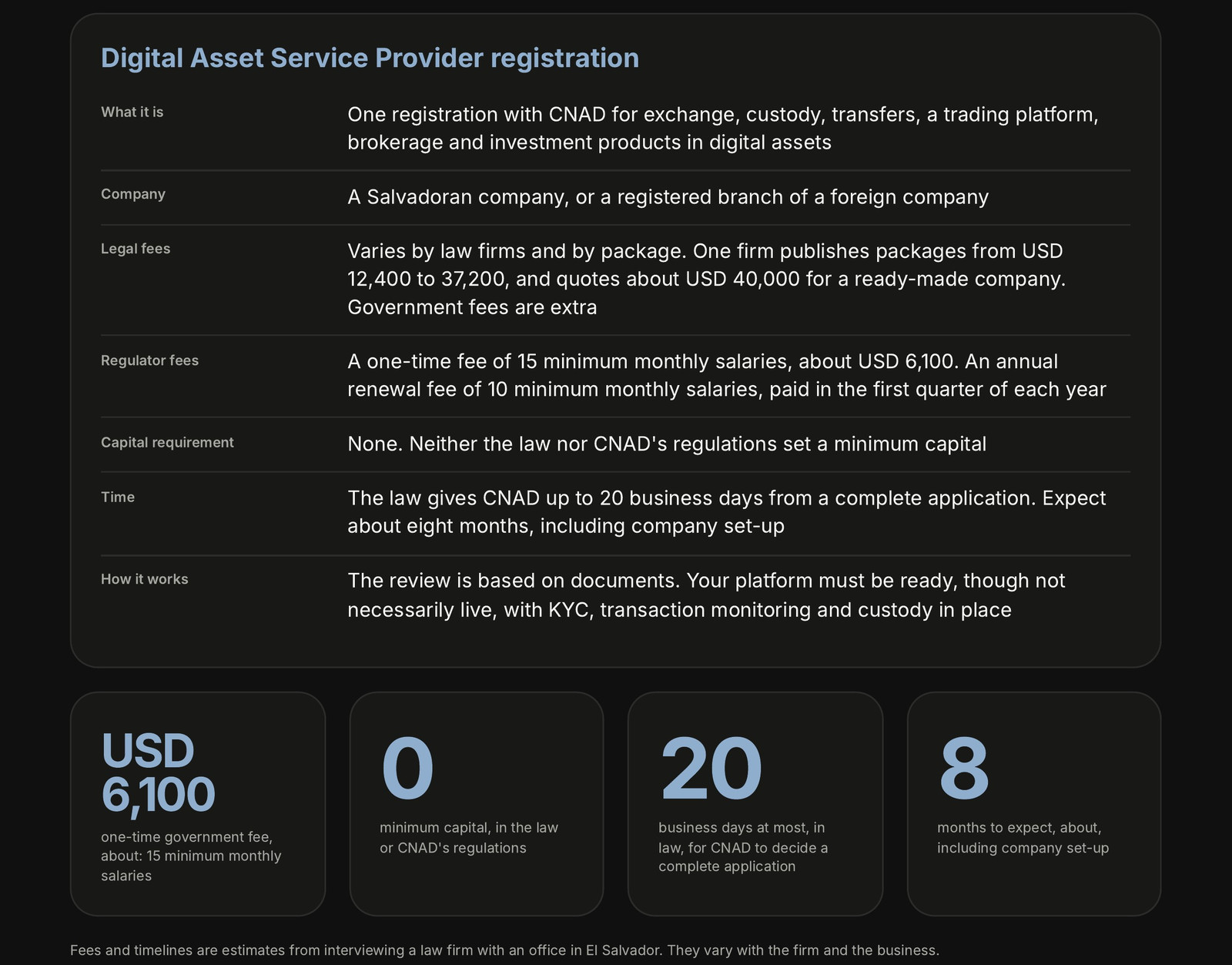
CNAD has a statutory decision period of 20 business days after receiving a complete application.
In practice, a law firm with an office in El Salvador advised allowing approximately eight months, including company incorporation and preparation.
The regulator closely examines a company's compliance systems.
Applicants are expected to have functioning KYC procedures, transaction monitoring and custody arrangements when they file. Their platform must be ready, even if it has not yet launched commercially.
Three restrictions to understand
First, registered DASPs can offer only the stablecoins on CNAD's approved list.
As of 22 October 2026, that list contained 12 tokens, including USDT, USDC and PYUSD.
Second, Bitcoin falls under a separate legal framework. A business offering Bitcoin services must also register as a Bitcoin Service Provider.
Third, registration in El Salvador provides no automatic right to offer services in other countries.
Companies must appoint two anti-money-laundering compliance officers and an information security officer.
Although the regulations permit compliance officers to live abroad if they are employees, CNAD's registration guide requires them to reside in El Salvador.
Issuing stablecoins
Issuers must maintain reserves equal to the value of the tokens in circulation.
The issuer's legal representative must sign a monthly sworn statement confirming the reserves.
The government fee is 0.01% of the amount the company expects to issue over the following twelve months.
If it cannot estimate issuance in advance, the fee is based on 0.01% of actual annual net issuance, capped at USD 300,000.
Israel: Getting licensed may be easier than opening a bank account
Israel regulates crypto businesses under its Regulated Financial Services Law of 2016.
The Capital Market, Insurance and Savings Authority (CMA) grants financial asset service licences to businesses that exchange, manage or safeguard crypto assets.
Applicants must operate through an Israeli company.
As of late June 2026, nine firms held the relevant licence, five of which had been licensed during 2026.
Capital requirements are increasing
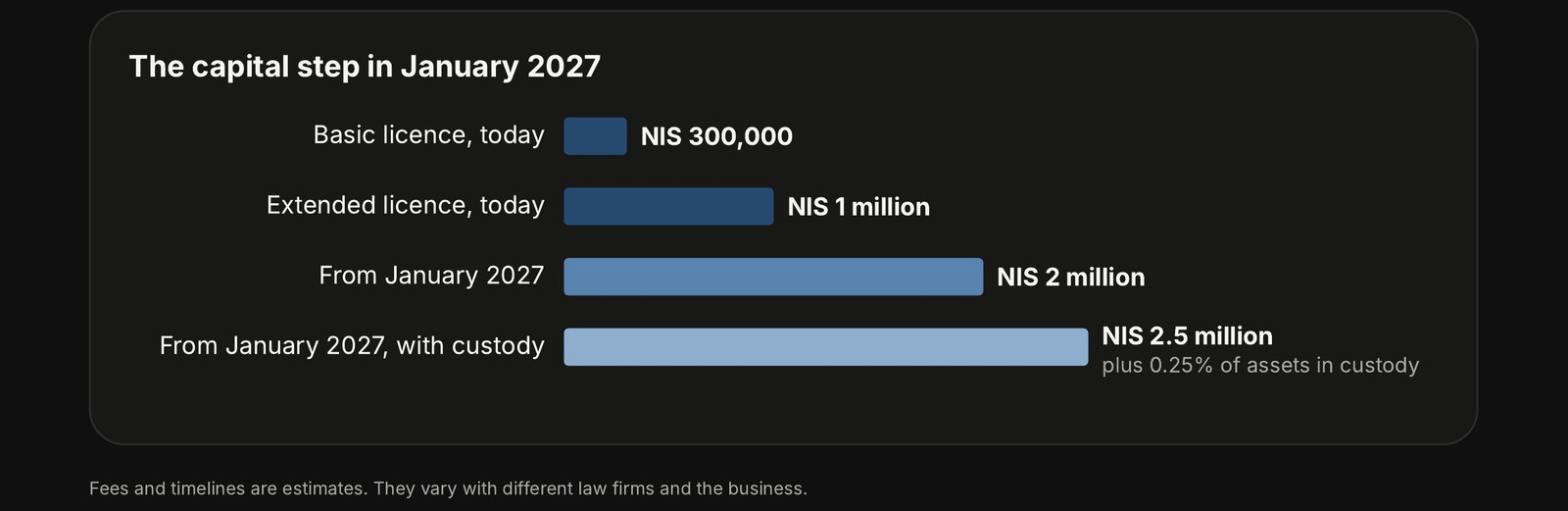
Israel is preparing for a significant change in January 2027.
Under the current rules, basic licence holders need NIS 300,000 in equity. Extended licence holders, including businesses with turnover above NIS 30 million, need NIS 1 million.
From January 2027, the own-funds requirement will rise to NIS 2 million.
For custodians, it will increase to NIS 2.5 million plus 0.25% of assets under custody.
Businesses will also be required to segregate customer assets.
The report estimates legal fees starting at about EUR 40,500 for a basic application, assuming six months of legal work at EUR 6,750 per month.
Licence-fee regulations had not been finalised as of October 2026.
The statutory review period is 70 days, but requests for additional documents restart the clock.
Banking access is the bigger obstacle
One of the most useful findings from our interviews concerns banking.
For a crypto business entering Israel, securing a bank account can be more difficult than obtaining the licence itself.
A Bank of Israel directive taking effect on 1 May 2027 will prevent banks from rejecting payment services solely because the funds originate from crypto activity.
Until that change takes effect, local practitioners recommend arranging banking relationships before submitting a licence application.
Stablecoin issuance remains under development
Israel has not yet introduced a dedicated stablecoin law.
In April 2026, the CMA approved BILS, the first shekel-denominated stablecoin, issued by Bits of Gold under the existing framework after a two-year regulatory sandbox pilot.
A memorandum published on 29 June 2026 proposed a dedicated stablecoin issuer licence.
However, no bill was introduced before the Knesset dissolved on 17 July 2026. Following the general election on 27 October 2026, the proposals will need to be considered by the new parliament.
A separate proposal for licensing foreign providers is also pending.
United Arab Emirates: Five regulators, different licensing routes
The UAE is one of the more complex jurisdictions in the report.
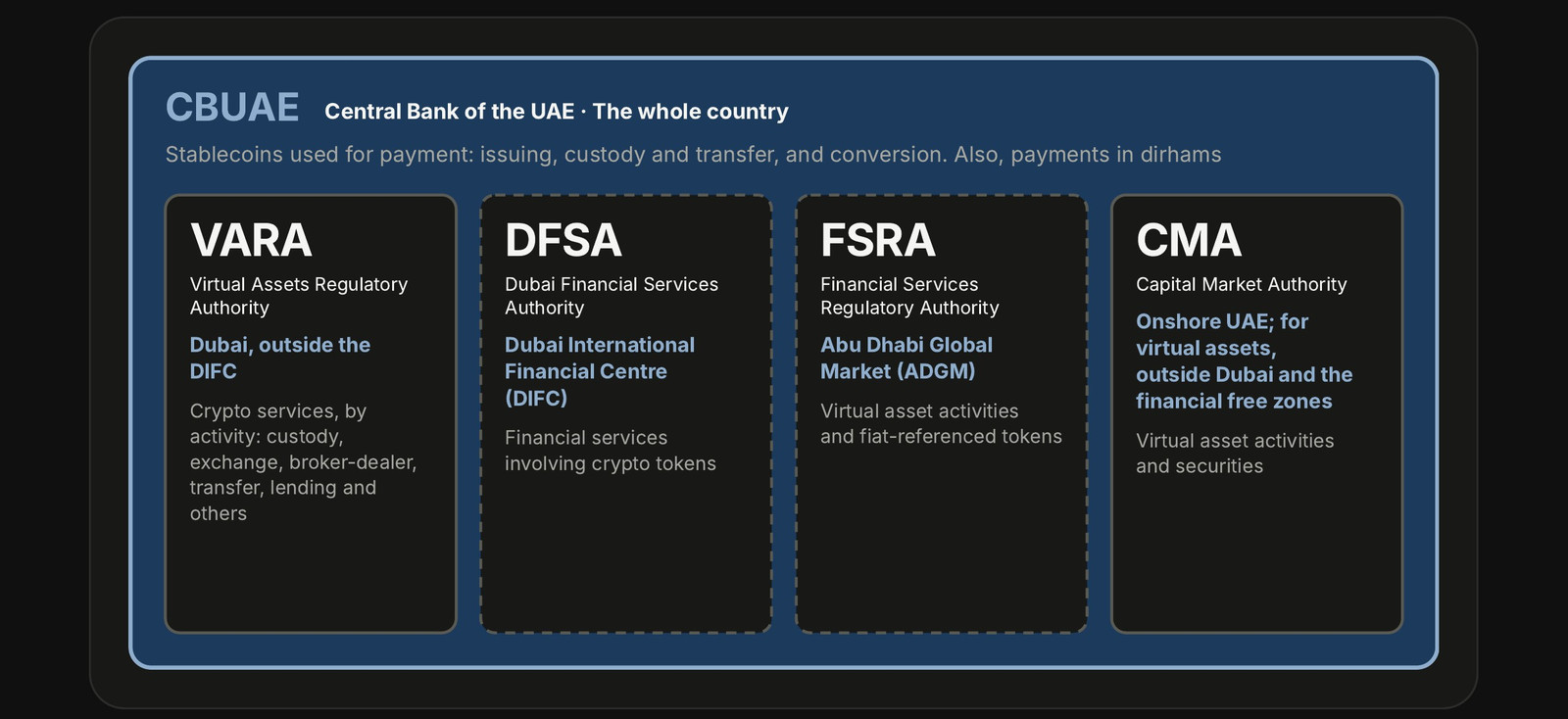
Five financial regulators oversee different parts of the digital asset market, and the correct licensing route depends on where a business is established and what services it offers.
The Central Bank of the UAE (CBUAE) regulates stablecoins used for payments nationwide.
Other digital asset services fall under the relevant territorial regulator:
- Dubai's Virtual Assets Regulatory Authority (VARA).
- Dubai Financial Services Authority (DFSA) in the DIFC.
- Financial Services Regulatory Authority (FSRA) in Abu Dhabi Global Market.
- The federal Capital Market Authority (CMA).
Payment stablecoins face particular restrictions
For businesses building payment products, the denomination of the stablecoin matters.
Only dirham-denominated stablecoins issued by licensed entities may be used to pay for goods and services.
Foreign-currency stablecoins such as USDT and USDC may be used to purchase virtual assets or their derivatives, but not for ordinary payments for goods and services.
That distinction can materially affect a company's business model.
VARA licensing costs
For a company seeking authorisation in Dubai under VARA, application fees range from AED 40,000 to AED 100,000 per activity.
Annual supervision fees range from AED 80,000 to AED 200,000 per activity.
Practitioners interviewed for the report put legal fees in the tens of thousands of US dollars, approaching six figures for a complex exchange.
Minimum capital requirements include:
| Activity | Minimum capital |
|---|---|
| Transfer services | AED 500,000 |
| Custody | AED 600,000 |
| Exchange with licensed custodian | AED 800,000 |
| Exchange without licensed custodian | AED 1,500,000 |
A higher requirement applies where the relevant share of annual overheads exceeds these amounts.
VARA does not set a statutory approval deadline.
For a well-prepared applicant, advisers generally estimate six to ten months.
Issuing a dirham stablecoin
Stablecoin issuance under the Central Bank is a considerably larger undertaking.
An issuer needs at least AED 15 million in capital, plus 0.5% of the value of tokens outstanding.
Advisers estimate legal fees of USD 150,000 to USD 200,000 for a new issuer, potentially reaching USD 250,000 for a more complex project.
The expected timeline is approximately 15 to 20 months.
As of 6 September 2026, the Central Bank's register listed three licensed dirham stablecoin issuers.
A fourth had received approval in principle. USDU was the only registered foreign stablecoin.
One licence does not necessarily cover everything
Companies licensed by VARA or the CMA may still need a non-objection registration from the Central Bank before converting stablecoins or holding and transferring foreign-currency stablecoins.
VARA also requires two Responsible Individuals: senior, full-time personnel who are UAE residents or passport holders.
There is uncertainty around the Central Bank's transition arrangements.
A one-year grace-period extension for VARA licensees has been reported, but it had not been confirmed in writing. As of 29 October 2026, the Central Bank had not announced a general extension.
Companies should therefore verify their position with the relevant authorities before relying on any assumed exemption.
Nigeria: High capital requirements and a licensing regime still taking shape
Nigeria introduced a new legal foundation for digital assets through the Investments and Securities Act 2025.
The Securities and Exchange Commission (SEC) oversees exchanges, custodians and token issuers.
However, an executive order announced in July 2026 placed certain payment, settlement and custody services involving non-security digital assets under the Central Bank of Nigeria (CBN).
The two regulators were expected to develop a joint framework, but no such framework had been published by 31 October 2026.
There was also no published test clearly separating securities from non-security digital assets.
For companies entering Nigeria, this creates an immediate question: which regulator has jurisdiction over the proposed activity?
The legal practitioner interviewed for the report recommends obtaining a legal opinion on whether the relevant token or service qualifies as a security.
Depending on its activities, a stablecoin business may need to deal with both regulators.
No firms had completed full registration
By August 2026, 14 firms held approval in principle from the SEC.
None had received full registration.
The regulator has made clear that approval in principle is not a final licence.
New applicants must enter through its regulatory incubation programme. The rules do not specify a fixed processing timeline.
One contributor to our report spent around 30 months moving from initial engagement with the SEC to conditional approval in principle.
Capital requirements
Nigeria's minimum capital requirements vary by activity.
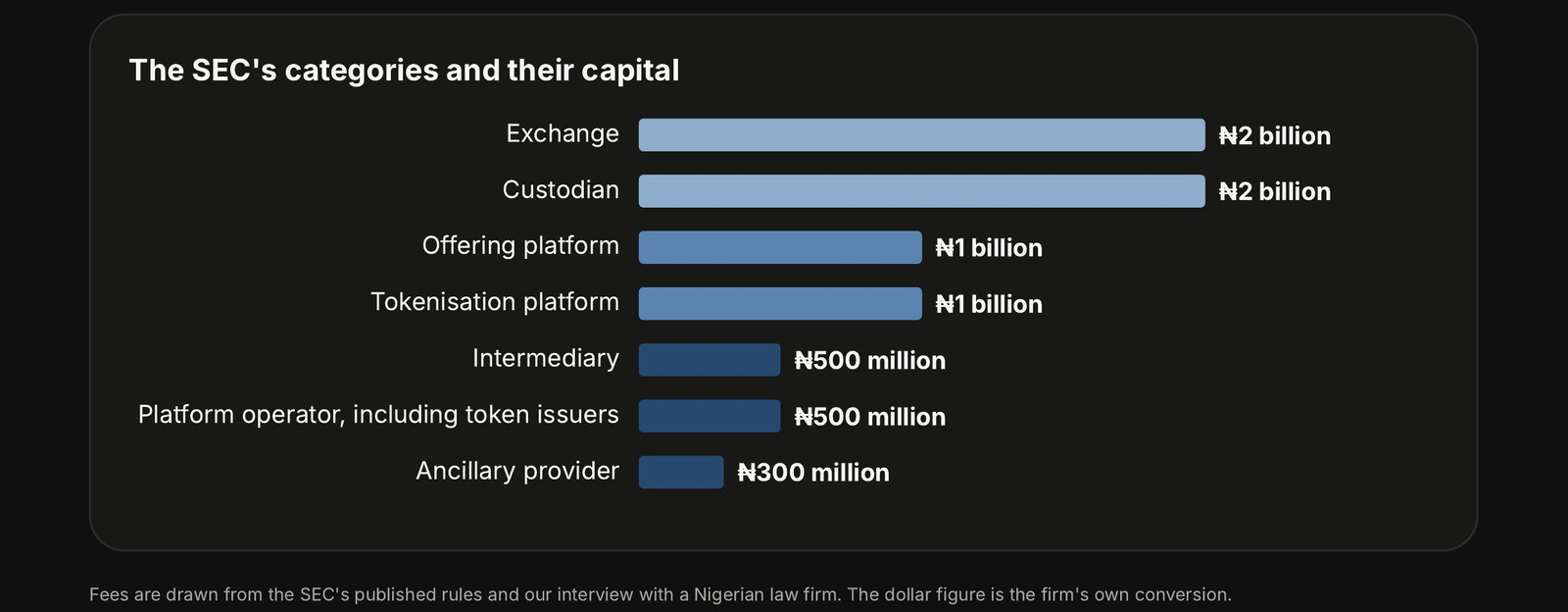
| Activity | Minimum capital |
|---|---|
| Exchange or custodian | ₦2 billion |
| Offering or tokenisation platform | ₦1 billion |
| Intermediary or platform operator, including token issuers | ₦500 million |
| Ancillary provider | ₦300 million |
Existing operators have until 30 June 2027 to meet the requirements.
New applicants must satisfy them before registration.
The application processing fee for the incubation programme is ₦2 million.
Under the 2022 rules, full registration for an exchange or offering platform carries a ₦30 million fee.
Proposed revisions published on 20 August 2026 would change some category requirements, but they had not been finalised at the report's cut-off.
Local incorporation and management
Applicants must be incorporated in Nigeria, maintain a local office and appoint a chief executive who lives in the country.
Companies with foreign shareholders also need ₦100 million in share capital, approximately USD 60,000 using the conversion provided by a Nigerian law firm interviewed for the report.
A Nigerian registration does not provide rights to operate elsewhere.
Stablecoin issuance remains an emerging area.
There is no dedicated issuer licence. The issuer of cNGN, a naira-denominated stablecoin, entered the SEC's incubation programme in July 2026.
In August, the CBN opened a regulatory sandbox track for testing stablecoin issuance models.
United Kingdom: A new regime with a February 2027 deadline
The UK is moving towards a broader authorisation framework for crypto businesses.
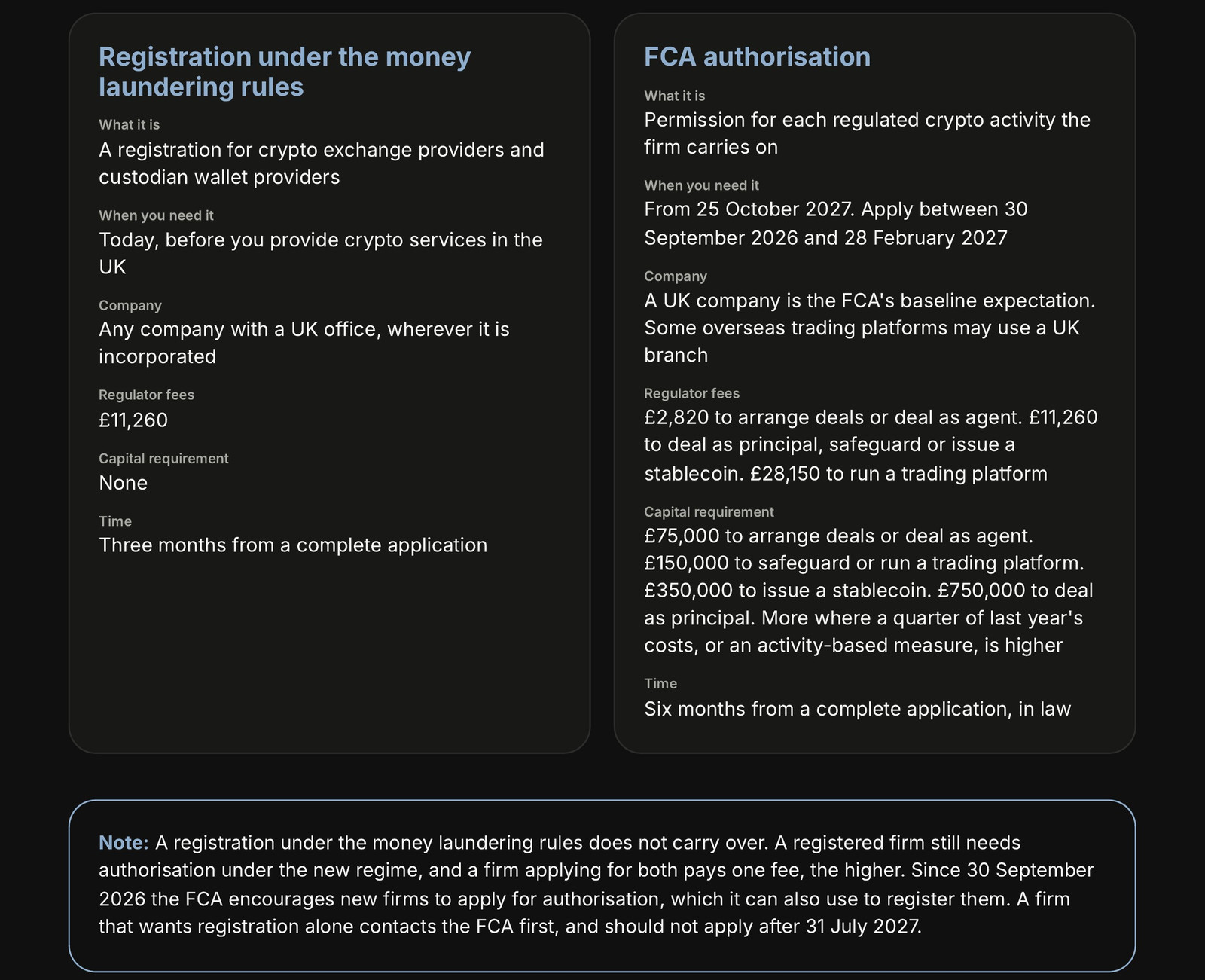
Under the current system, firms register with the Financial Conduct Authority (FCA) for anti-money-laundering supervision.
From 25 October 2027, a new regime will require FCA authorisation for major crypto activities, including stablecoin issuance, custody and trading platforms.
Applications opened on 30 September 2026.
The application window closes on 28 February 2027.
This deadline matters especially for businesses already registered under the current framework.
Existing registrations will not automatically convert into authorisations. Firms must apply again.
Those that miss the application window may have to suspend their regulated crypto activities when the new rules take effect.
Fees and minimum capital
The new regime introduces different requirements for each activity.
| Activity | Application fee | Minimum capital |
|---|---|---|
| Arranging deals or dealing as agent | £2,820 | £75,000 |
| Safeguarding crypto assets | £11,260 | £150,000 |
| Operating a trading platform | £28,150 | £150,000 |
| Issuing a stablecoin | £11,260 | £350,000 |
| Dealing as principal | £11,260 | £750,000 |
Higher capital requirements may apply based on a quarter of the firm's previous year's costs or the relevant activity-based measure.
The FCA has six months to decide on a complete application under the statutory framework.
The starting expectation is that an applicant will be incorporated in the UK, although some overseas trading platforms may operate through a UK branch.
Most crypto firms will also fall under the Senior Managers and Certification Regime, requiring FCA approval for specified senior management roles.
Crypto promotions remain subject to detailed conduct requirements, including prescribed risk warnings and a cooling-off period of at least 24 hours before a direct offer to a new retail customer.
Rules for stablecoin issuers
Stablecoin issuers will have to maintain reserves equal to the value of coins in circulation.
Backing assets must consist primarily of short-term deposits and short-term government debt, held on a statutory trust for holders.
Issuers must redeem stablecoins at par by the end of the business day following receipt of the tokens.
They will not be permitted to distribute interest earned on reserve assets to holders.
For sterling stablecoins designated as systemic by the Treasury, the Bank of England will supervise alongside the FCA.
The Bank plans to finalise its code of practice for systemic stablecoins by the end of 2026.
United States: Choosing between state licences and federal charters
The United States offers several routes into the regulated digital asset market, but none is straightforward.
The GENIUS Act, signed into law on 18 July 2025, introduces a federal framework for payment stablecoin issuance.
It takes effect on 18 January 2027.
Until then, companies continue operating under existing federal and state frameworks, which may involve money transmitter licences, state trust charters or a federal charter from the OCC.
For businesses offering stablecoin services nationwide, US law firms interviewed for the report recommend budgeting one to two years and a low-to-mid seven-figure amount.
There are two main routes.
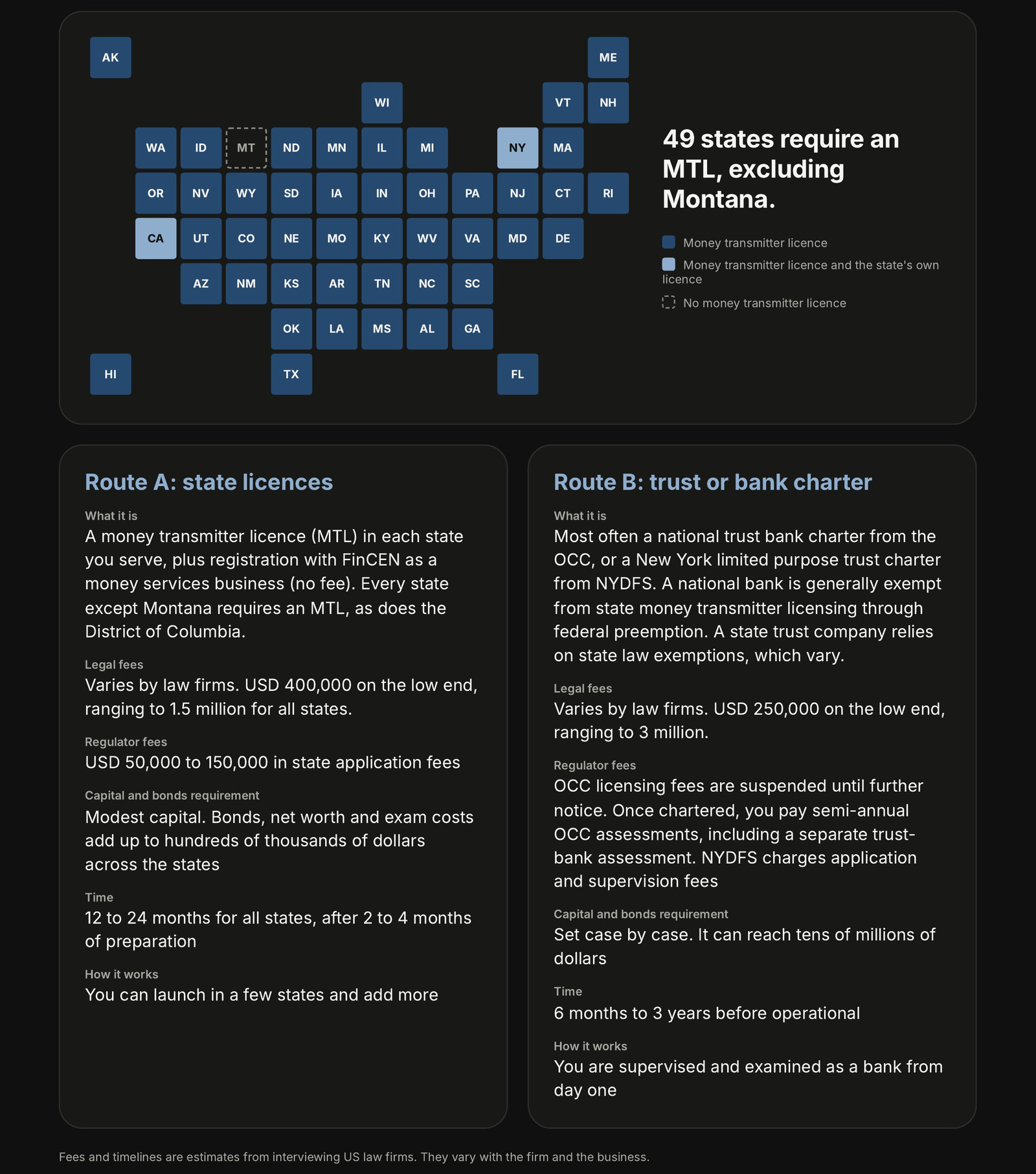
Route A: State money transmitter licences
Many companies begin by obtaining money transmitter licences in the states where they plan to serve customers.
Every state except Montana requires one, as does Washington, DC.
Companies also generally need to register with FinCEN.
The process becomes expensive because each state has its own requirements, application procedures and regulatory review.
US law firms interviewed for the report estimated:
- Legal fees starting around USD 400,000 and potentially reaching USD 1.5 million for nationwide coverage.
- State application fees totalling USD 50,000 to USD 150,000.
- Additional expenses running into hundreds of thousands of dollars for surety bonds, net-worth requirements and examinations.
- Approximately two to four months of preparation, followed by 12 to 24 months to obtain licences across all states.
New York and California introduce further considerations through the BitLicense regime and California's Digital Financial Assets Law.
Route B: A trust or bank charter
An alternative is to obtain a trust or bank charter.
The most relevant options for digital asset companies are often a national trust bank charter from the OCC or a New York limited purpose trust charter.
A national bank generally benefits from federal preemption of state money transmitter licensing requirements.
That can simplify nationwide operations, although the process of obtaining a charter is demanding.
Practitioners estimated legal fees of USD 250,000 to USD 3 million.
Capital is assessed individually and can reach tens of millions of dollars.
Depending on the application and the work needed before launch, the process can take six months to three years before the business becomes operational.
One issue remains unsettled: whether New York must exempt an OCC-chartered trust bank from its BitLicense requirements.
Stablecoin issuance under the GENIUS Act
Issuance follows a separate regulatory track.
Once the GENIUS Act takes effect, payment stablecoins may be issued in the US only by permitted payment stablecoin issuers.
Federal regulators will have 120 days to decide on substantially complete applications.
Under the OCC's rules, an application that has not been denied by day 120 is treated as approved.
Issuers must maintain at least one dollar of eligible reserves for every stablecoin outstanding and publish their reserve composition monthly.
They may not pay interest or yield to stablecoin holders.
The cost of building a compliant business
Obtaining authorisation is only one part of the investment.
Companies must also build the systems, controls, staffing and reporting infrastructure needed to operate under supervision.
The report estimates first-year compliance build costs of USD 1.5 million to USD 5 million for an early-stage company.
For a larger organisation, the cost could reach USD 5 million to USD 15 million or more.
Incomplete applications are one of the most common causes of delays. Every round of additional questions from a regulator can add months to the process.
Ten regulatory dates to watch
The regulatory landscape will continue changing well beyond the publication of this report.
These are ten dates and milestones companies should keep on their calendars.
| Date | Jurisdiction | What changes |
|---|---|---|
| 14 December 2026 (forecast) | European Union | Expected European Parliament vote on the Payment Services Regulation |
| End of 2026 | United Kingdom | Bank of England aims to finalise its code of practice for systemic stablecoins |
| January 2027 | Israel | Higher own-funds requirements and segregation of client assets take effect |
| 18 January 2027 | United States | GENIUS Act takes effect |
| 28 February 2027 | United Kingdom | FCA application window under the new crypto regime closes |
| 1 May 2027 | Israel | Banks may no longer refuse payment services solely because funds originate from crypto activity |
| 30 June 2027 | Nigeria | Deadline for existing operators to meet SEC minimum capital requirements |
| 10 July 2027 | European Union | EU Anti-Money Laundering Regulation begins applying directly to crypto-asset service providers |
| 25 October 2027 | United Kingdom | New crypto authorisation regime begins |
| 18 July 2028 | United States | Digital asset service providers may offer only stablecoins issued by permitted issuers |
These are only some of the changes covered in the report. Several countries are still developing their frameworks, and other requirements may change as new legislation is adopted or regulators publish further guidance.
Where to go from here
There is no single approach to stablecoin licensing that works everywhere.
Some countries offer relatively straightforward registration routes. Others require substantial capital, local management teams and lengthy regulatory reviews. In several markets, the legal framework is still being developed.
Even within a common framework such as MiCA, companies need to understand how local regulators interpret the rules and what operating a licensed business will cost in practice.
That is why we produced The State of Global Stablecoin Licensing.
The aim is not to replace local legal advice or provide an exhaustive analysis of every regulatory provision. It is to give companies a practical starting point when evaluating a new market.
Most country sections in the full report include a service-by-service licensing table, capital and fee requirements, compliance staffing, practical considerations, common pitfalls and references to the governing legislation.
The report was published in partnership with Utila's Licensed Partner Network and Bluechip, an independent stablecoin rating agency.
Download The State of Global Stablecoin Licensing to explore the complete research.
Anvesan Research. This publication is intended for market research and educational purposes only. It does not constitute legal or investment advice.