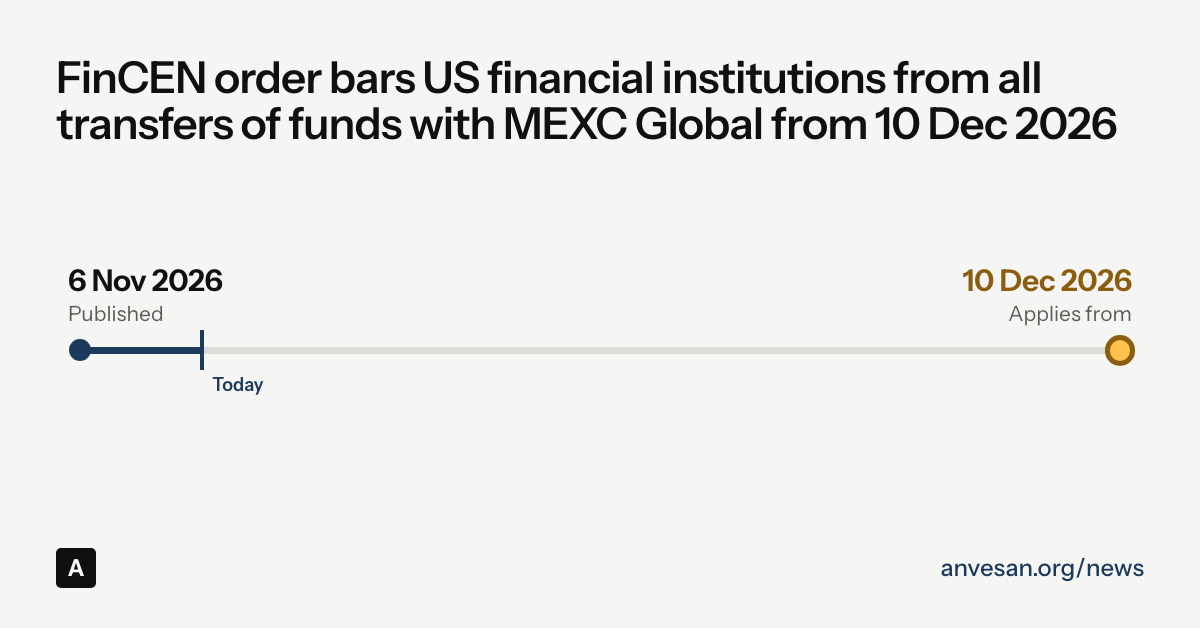
FinCEN order bars US financial institutions from all transfers of funds with MEXC Global from 10 Dec 2026
FinCEN issued a section 9714 order that will prohibit covered financial institutions from any transmittal of funds, including CVC, from or to MEXC Global.
- Effective date
Summary
- FinCEN issued a section 9714 order against MEXC Global
- Covered institutions barred from MEXC transfers from 10 Dec 2026
- Prohibition covers convertible virtual currency transfers too
- Order takes effect on 10 Dec 2026
- Order has no cessation date; exemptions remain possible
What happened
On 6 Nov 2026 the Financial Crimes Enforcement Network (FinCEN) issued an order under section 9714(a) of the Combating Russian Money Laundering Act against MEXC Global, a convertible virtual currency (CVC) exchanger. FinCEN found that MEXC Global is a financial institution operating outside the United States of primary money laundering concern in connection with Russian illicit finance. FinCEN says the order effectively cuts MEXC Global off from the US financial system. The Federal Register published the order on 10 Nov 2026.
What changed
The order states: "A covered financial institution is prohibited from engaging in any transmittal of funds from or to MEXC Global." A covered financial institution has the same meaning as "financial institution" in 31 CFR 1010.100(t). The order defines transmittals of funds as the sending and receiving of funds, including CVC.
The order defines MEXC Global to include its branches, subsidiaries and offices operating as a financial institution outside the United States, and any successor entity: a person that replaces MEXC Global by acquiring its assets, in whole or in part, or carrying on its affairs under a new name. Footnote 1 says this includes, but is not limited to, active and past affiliates in Seychelles, Estonia, Switzerland and the United Kingdom, and former Singapore entities. MEXC Global's branches, subsidiaries and offices located in the United States are excluded.
FinCEN assesses that there are few, if any, readily available ways to reject incoming CVC before receipt. It says the order gives covered financial institutions flexibility in how they comply, acting with discretion on the facts of a particular transaction even where the originating address is no longer accessible. Its examples are CVC from MEXC Global held for an extended period in an unhosted wallet, and risk procedures that would preclude returning funds to MEXC Global. The order does not change obligations under the Bank Secrecy Act, including Suspicious Activity Report filing, or sanctions administered by the Office of Foreign Assets Control (OFAC).
Who is affected
- Financial institutions as defined in 31 CFR 1010.100(t), including banks and money services businesses such as CVC exchangers.
- Customers of covered financial institutions who send funds to, or receive funds from, MEXC Global, since from 10 Dec 2026 their institutions are prohibited from processing those transmittals.
What happens next
The order takes effect on 10 Dec 2026, with no cessation date. FinCEN reserves authority to impose conditions on certain transmittals of funds from or to MEXC Global and to grant exemptions. Wilful violations may bring civil or criminal penalties.
According to FinCEN, MEXC Global is incorporated in Seychelles without a virtual asset service provider licence. Treasury says MEXC Global facilitated at least $16 billion in funds connected to sanctions evasion, cybercrime and other illicit activity between May 2021 and May 2026.
Anvesan view
The prohibition covers CVC transfers too. The order gives firms discretion on the facts of a particular transaction in how they handle incoming CVC from MEXC Global, even where the originating address is no longer accessible, and FinCEN reserves authority to grant exemptions or impose conditions.
Official source
Source: Financial Crimes Enforcement Network (FinCEN), order, pre-publication copy, published 6 Nov 2026.
Corrections
- : The Federal Register published the order on 10 Nov 2026. It takes effect on 10 Dec 2026. The story first gave the effective date only as 30 days after Federal Register publication, as FinCEN's pre-publication copy did.
Published Updated