NYDFS issues advertising and marketing guidance for BitLicensees and virtual currency trust companies
Virtual currency firms licensed or chartered in New York must have marketing policies available for NYDFS review from 12 May 2027.
- Effective date
Summary
- NYDFS issues advertising guidance for virtual currency firms
- Covers BitLicensees and limited purpose trust companies
- Board or board subcommittee approves policies annually
- Disclosures must be clear and conspicuous
- Policies must be available for review from 12 May 2027
What happened
The New York State Department of Financial Services (NYDFS) issued an industry letter, Guidance on Advertising and Marketing, on 12 Nov 2026. The letter is from Acting Superintendent Kaitlin Asrow. The letter is addressed to virtual currency businesses licensed under 23 NYCRR Part 200, known as BitLicensees, and to limited purpose trust companies chartered under the New York Banking Law to engage in virtual currency business activity. The letter calls them virtual currency entities (VCEs). It is issued guidance, not a proposal.
What changed
The letter says VCEs must develop, maintain and enforce policies and procedures on advertising and marketing. The VCE's board of directors, or a designated subcommittee of the board, must review and approve them on an annual basis. They must be commensurate with the VCE's size, customer base and business model.
The letter sets out three areas.
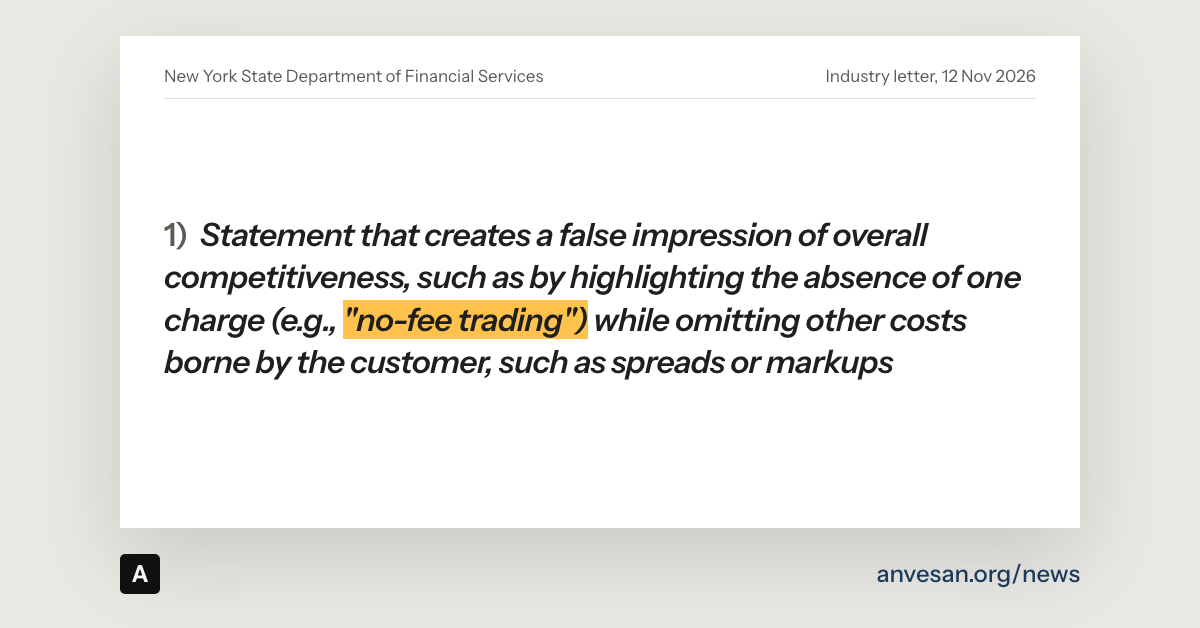
- Content. Materials must not make false, misleading or deceptive representations or omissions. The letter's examples include highlighting "no-fee trading" while omitting spreads or markups, misstating time periods in performance claims, and misrepresenting an individual's or entity's licensure status.
- Disclosures. Disclosures must be clear and conspicuous. Materials that reference potential benefits should also give a balanced discussion of risk. The nature and amount of compensation for testimonials should be conspicuously stated. The letter's examples of poor placement include disclosures given only at the end of a podcast after significant discussion of potential benefits, and risks disclosed only after a customer engages with a "click for more" mechanism.
- Governance. NYDFS expects a formal review and approval process with secondary review, monitoring for impersonation accounts and unauthorized promotional schemes, due diligence on third-party promoters, and record controls consistent with 23 NYCRR 200.18.
The letter defines Materials as any content produced or distributed by a VCE or on its behalf that could reasonably be viewed as promoting or inducing engagement with its virtual currency products, services or activities. Such content is in scope regardless of how it is labeled, including as "education", and regardless of channel, including social media, newsletters and presentations.
Who is affected
BitLicensees and limited purpose trust companies chartered for virtual currency business in New York. The letter also expects effective policies to include due diligence on, and monitoring of, the third-party promoters a VCE selects and retains.
What happens next
From 12 May 2027, policies and procedures consistent with the guidance must be available for NYDFS review, according to the letter. The NYDFS press release announcing the letter says VCEs are expected to update their policies by 10 May 2027. NYDFS says it will assess the policies and their efficacy through examinations and supervisory monitoring.
Anvesan view
The letter requires annual approval of marketing policies by the board or a designated board subcommittee, and sets 12 May 2027 as the date from which they must be available for NYDFS review. In its press release, NYDFS says it will assess them through examinations and supervisory monitoring.
Official source
Source: New York State Department of Financial Services (NYDFS), industry letter, published 12 Nov 2026.
Published