A company that holds or moves stablecoins for US customers has two routes. It can collect money transmitter licences state by state, or it can get a trust or bank charter, most often a national trust bank charter from the Office of the Comptroller of the Currency (OCC).
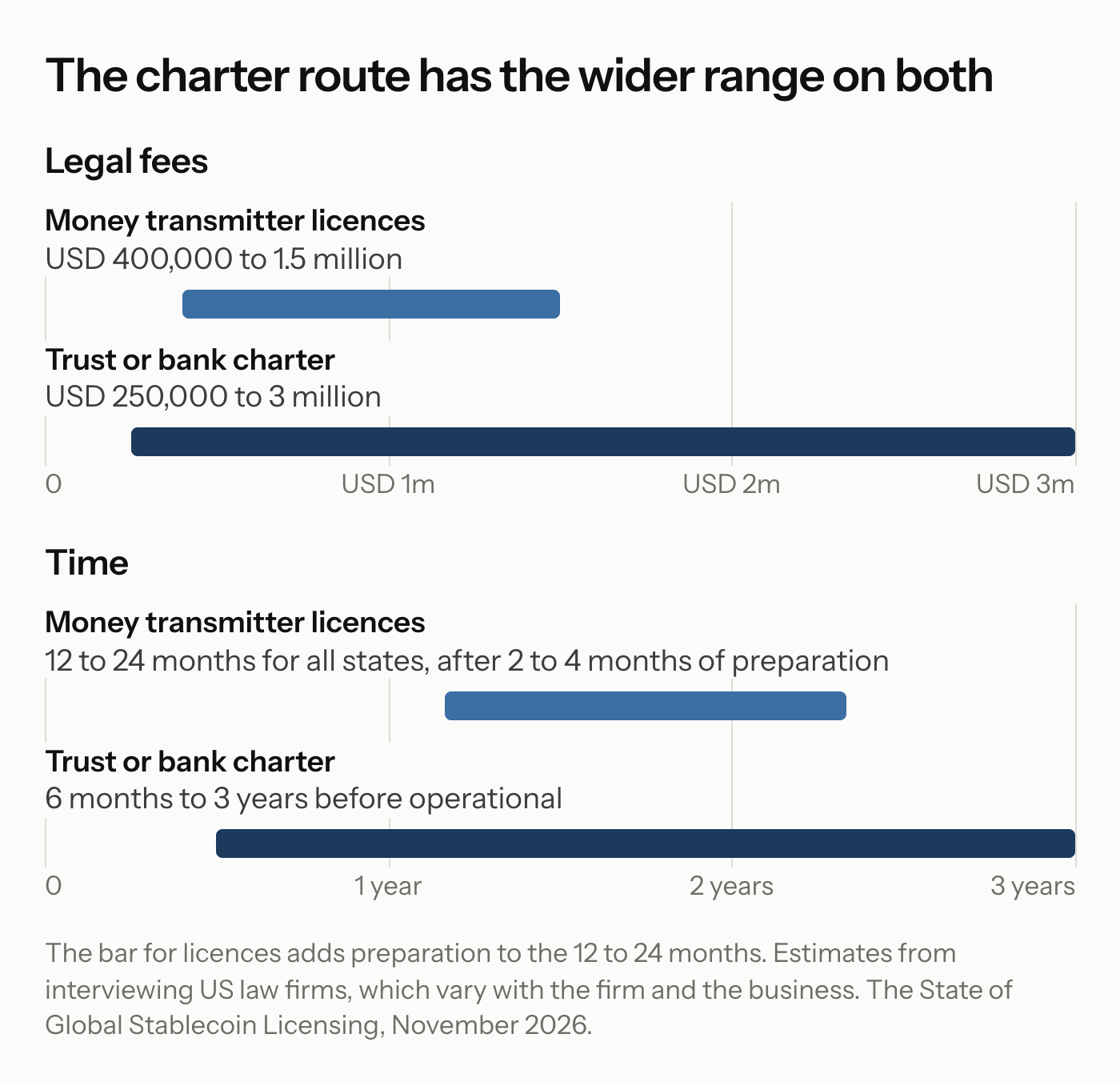
Most companies start with state licences and later consider a charter as volumes grow. The charter route has the wider range of cost and time, and it brings supervision as a bank from day one.
Switch routes below, and select a state to see what applies there.
The estimates here come from US law firms interviewed for The State of Global Stablecoin Licensing, Anvesan's report of November 2026. They vary with the firm and the business.
Money transmitter licenses vs trust charters at a glance
| Money transmitter licences | Trust or bank charter | |
|---|---|---|
| What it is | A licence in each state you serve, plus registration with FinCEN as a money services business (no fee) | Most often a national trust bank charter from the OCC, or a New York limited purpose trust charter |
| Legal fees (estimate) | USD 400,000 on the low end, ranging to 1.5 million for all states | USD 250,000 on the low end, ranging to 3 million |
| Regulator fees | USD 50,000 to 150,000 in state application fees (estimate) | OCC licensing fees are suspended until further notice. Once chartered, semi-annual OCC assessments. New York charges application and supervision fees |
| Capital and bonds | Modest capital. Bonds, net worth and exam costs add up to hundreds of thousands of dollars across the states (estimate) | Set case by case. It can reach tens of millions of dollars (estimate) |
| Time (estimate) | 12 to 24 months for all states, after 2 to 4 months of preparation | 6 months to 3 years before operational |
| How it works | You can launch in a few states and add more | You are supervised and examined as a bank from day one |
Cost and time
Neither route is cheap for nationwide coverage, and the two ranges overlap. The charter can cost less in legal fees than a full set of state licences, or twice as much.
Compliance adds to either route. The report estimates a first-year compliance build of USD 1.5 million to 5 million for an early-stage company, and USD 5 million to 15 million or more for a large organisation. Outsourcing is common, but the regulator holds the licensee responsible for any failure.
What the state route involves
Every state except Montana requires a money transmitter licence, as does the District of Columbia. Each state sets its own terms.
Among the five states in Anvesan's state-by-state guide, base application fees run from USD 375 in Florida to USD 4,000 in Minnesota, where the sources state a fee. Where those laws state a minimum surety bond, it runs from USD 10,000 in Washington to USD 100,000 in Minnesota and in Texas's 2023 Act. Minnesota and Texas's 2023 Act also treat a complete application as approved if the commissioner does not decide within 120 days, though Texas's commissioner may extend that period for good cause.
Two states add their own regime:
- New York requires a BitLicense, with a USD 5,000 application fee and an estimated 12 to 24 months, unless the company is a New York trust company.
- California's Digital Financial Assets Law requires a licence from the Department of Financial Protection and Innovation for exchanging, transferring or storing digital assets for California residents.
The advantage is sequence. A company can launch in a few states and add more as it grows.
What a charter changes
A national bank is generally exempt from state money transmitter licensing through federal preemption. That has limits. California exempts a federal trust bank, but whether New York exempts an OCC trust bank from the BitLicense remains unsettled. A state trust company relies on state law exemptions, which vary.
The cost of that reach is supervision. The OCC approves the specific activities in your business plan, and new activities later need its non-objection. The OCC said in March 2026 that it supervises approximately 60 national trust banks.
The clock also runs after approval. In each 2026 OCC decision Anvesan checked, preliminary conditional approval expires if the bank's capital is not raised within 12 months, or the bank does not open within 18 months.
Who is taking this route
The report counts 34 companies that have filed with the OCC for a national charter to run a digital-asset or stablecoin business.
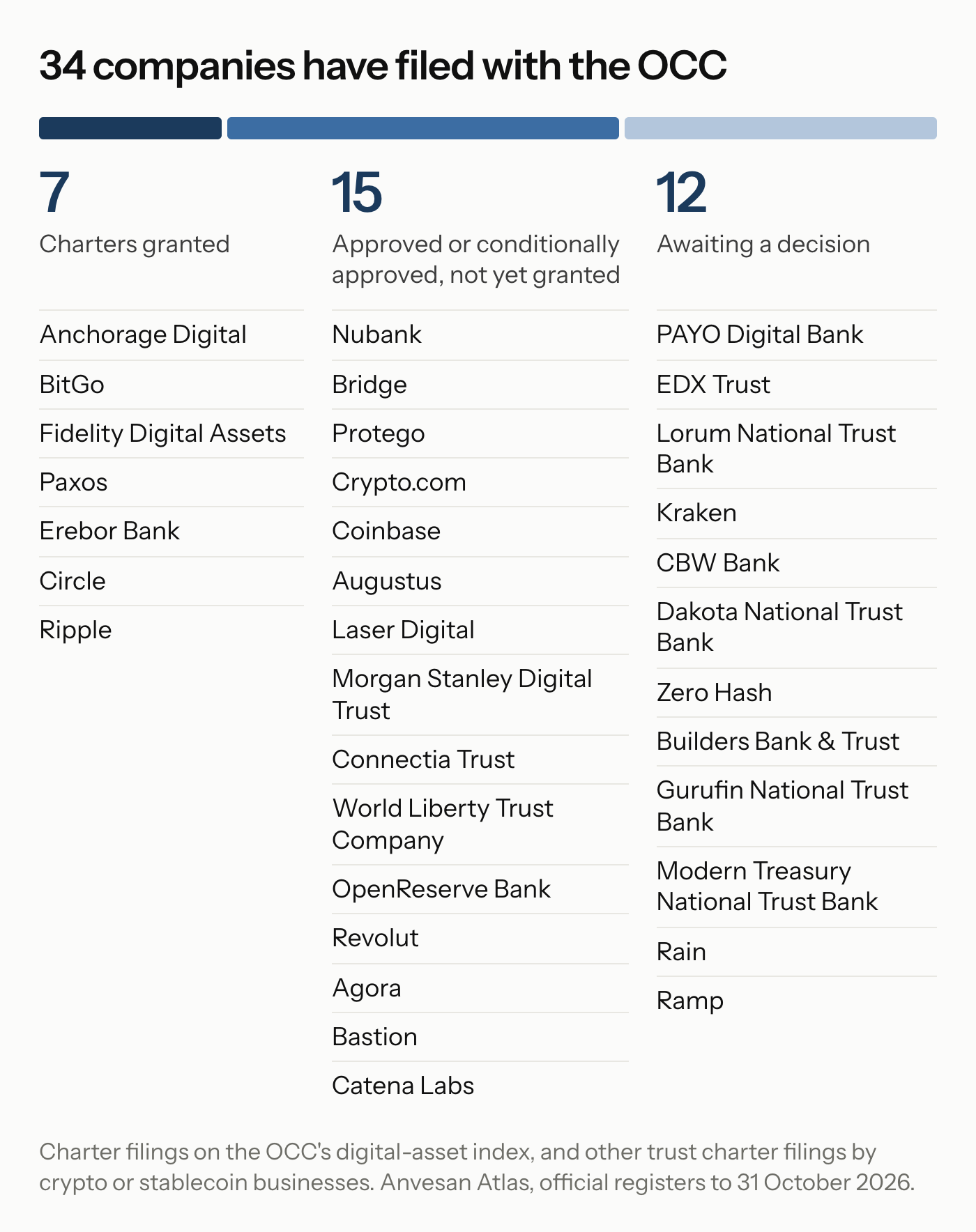
Some started with a state charter. BitGo, Fidelity Digital Assets and Paxos were state trust companies. The OCC conditionally approved their conversions on 12 December 2025, and the report now counts them among the charters granted.
Where the GENIUS Act fits
Neither route is approval to issue. The GENIUS Act takes effect on 18 January 2027, and from then only a permitted payment stablecoin issuer may issue a payment stablecoin in the US.
There are three types: a subsidiary of an insured depository institution, a federal qualified issuer approved by the OCC, including a nonbank, and a state qualified issuer limited to USD 10 billion outstanding. A federal regulator must decide within 120 days of a substantially complete application, and the OCC's rule treats one it has not denied by day 120 as approved. Sherpa lists minimum capital of at least USD 5,000,000 for OCC-supervised issuers from 18 January 2027, as checked on 31 October 2026.
The Act also reaches companies that only offer stablecoins. From 18 July 2028, digital asset service providers may offer only stablecoins from permitted issuers.
Common pitfalls on either route
- An incomplete first filing. Regulators send it back with questions, and each round adds months.
- An unrealistic business plan or a weak compliance programme.
- Changes in ownership or key staff while the application is pending.
How to choose
The report's starting point is that most companies begin with state licences. These questions help weigh that.
How many states do you need at launch? State licences suit a company that can start in a few states and add more.
Who are your clients? New York's regulator says a limited purpose trust company can custody assets as a fiduciary, which many pension funds, registered investment advisers and other regulated institutional clients often require.
How much capital can you commit? Modest capital plus bonds on one route, a case-by-case figure that can reach tens of millions of dollars on the other.
Do you need New York? The BitLicense question stays open for an OCC trust bank.
To see the requirements for your service, open the US path in Sherpa's Pathfinder, free with an account.
This guide is planning information from official sources and practitioner estimates, not legal advice. Confirm the details with a US law firm before you file.