MiCA is in force now, and a licence from any of its 30 countries can be used in all of them. The UK's own regime starts on 25 October 2027, and the Financial Conduct Authority (FCA) says firms that intend to keep operating there should apply by 28 February 2027.
The UK is not one of the 30. A firm planning to serve customers in both markets should expect to deal with both regimes, on two different calendars.
Pick an activity to see what each regime asks for.
The figures here come from The State of Global Stablecoin Licensing, Anvesan's report of November 2026, which reflects information available on 25 October 2026. Application fees by MiCA country come from Anvesan Sherpa, and each is dated between 19 September and 31 October 2026.
UK vs MiCA at a glance
| United Kingdom | MiCA | |
|---|---|---|
| Status | New regime starts 25 October 2027. Firms register under the money laundering rules today | In force. The transition ended on 1 July 2026 |
| Regulator | Financial Conduct Authority | Each country's own, such as the FMA in Austria or the MFSA in Malta |
| Where it can be used | The United Kingdom | All 30 EEA countries, by passporting |
| Company | A UK company is the baseline. Some overseas trading platforms may use a UK branch | A company with an EU-resident director, plus local rules |
| Minimum capital | £75,000 to £750,000, by activity | EUR 50,000 to EUR 150,000, by service |
| Application fee | £2,820 to £28,150, by activity | Set by each regulator |
| Decision time in law | Six months from a complete application | 40 working days from a complete application |
Where each license can be used
MiCA is one set of rules for all 27 EU countries, and through the EEA Agreement it also applies in Iceland, Liechtenstein and Norway. To passport, a firm tells its home regulator which countries and services it will add. It may start once the regulator confirms it has passed this on, or on the 15th calendar day after filing, whichever comes first.
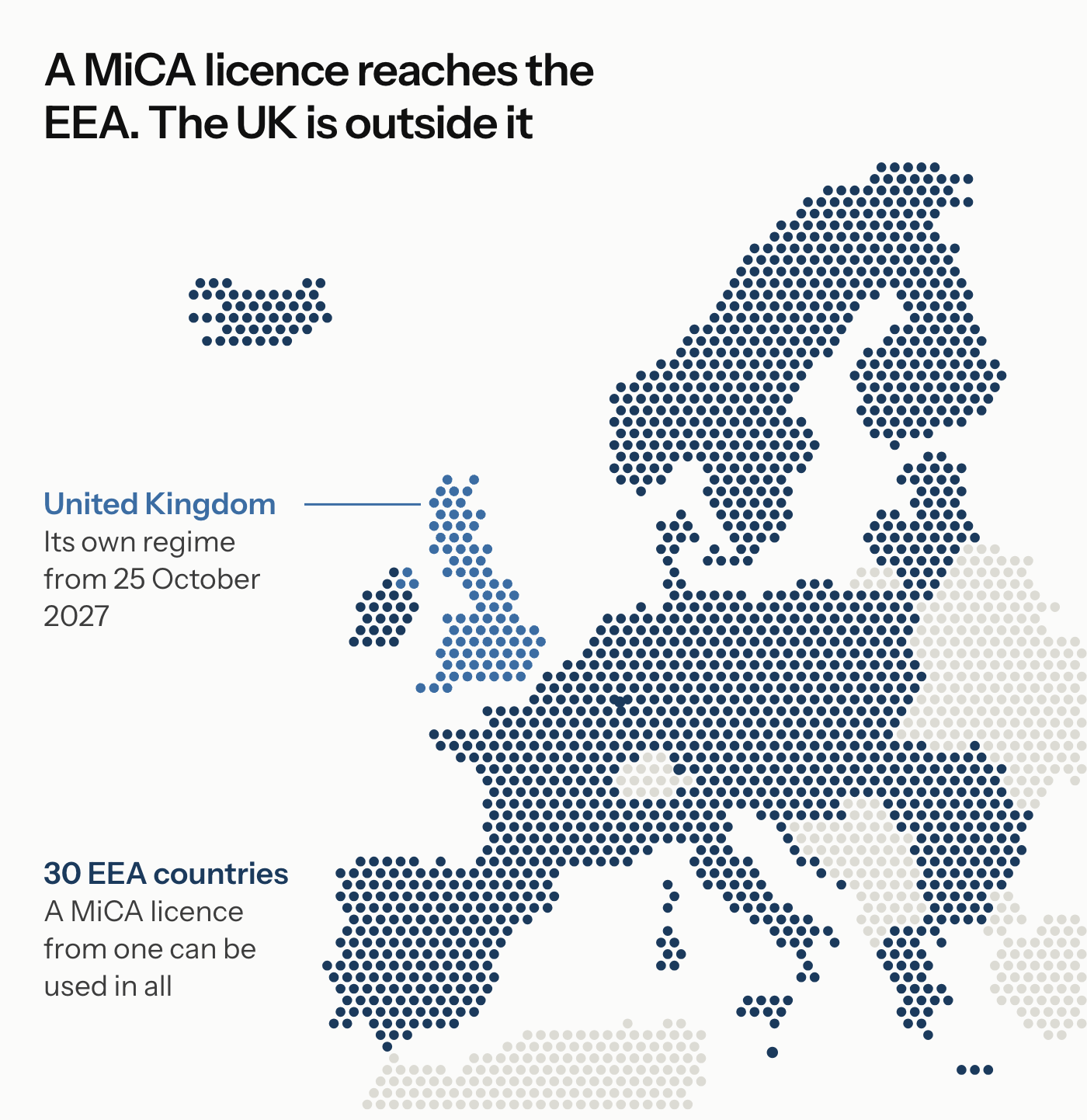
Many firms do not use all of that reach. Of 379 MiCA providers on the registers to 31 October 2026, 143 passport into all 29 other EEA countries. The largest group, 151 providers, passport into none.
The UK regime has no equivalent. The FCA's baseline expectation is a UK company, and only some overseas trading platforms may use a UK branch.
Capital and fees
Minimum capital
The widest gap is in dealing. In the UK, a firm dealing as principal needs £750,000, and a firm dealing as agent needs £75,000. Under MiCA, a licence with exchange takes EUR 125,000, and order execution takes EUR 50,000.
Other activities are closer. Custody takes £150,000 in the UK, against EUR 125,000 under MiCA. A trading platform takes £150,000 in the UK, against EUR 150,000 under MiCA.
The two regimes do not define their activities the same way, so these pairings are Anvesan's closest match, not an official one.
These are floors in both regimes. UK capital rises where a quarter of last year's costs, or an activity-based measure, is higher. MiCA capital rises to a quarter of the previous year's fixed overheads when that is higher.
Application fees
The UK has one fee schedule: £2,820 to arrange deals or deal as agent, £11,260 to deal as principal, safeguard or issue a stablecoin, and £28,150 to run a trading platform.
MiCA has no single fee, because each regulator sets its own. The Netherlands is at the top of the chart below, charging up to EUR 100,000 at EUR 200 an hour.
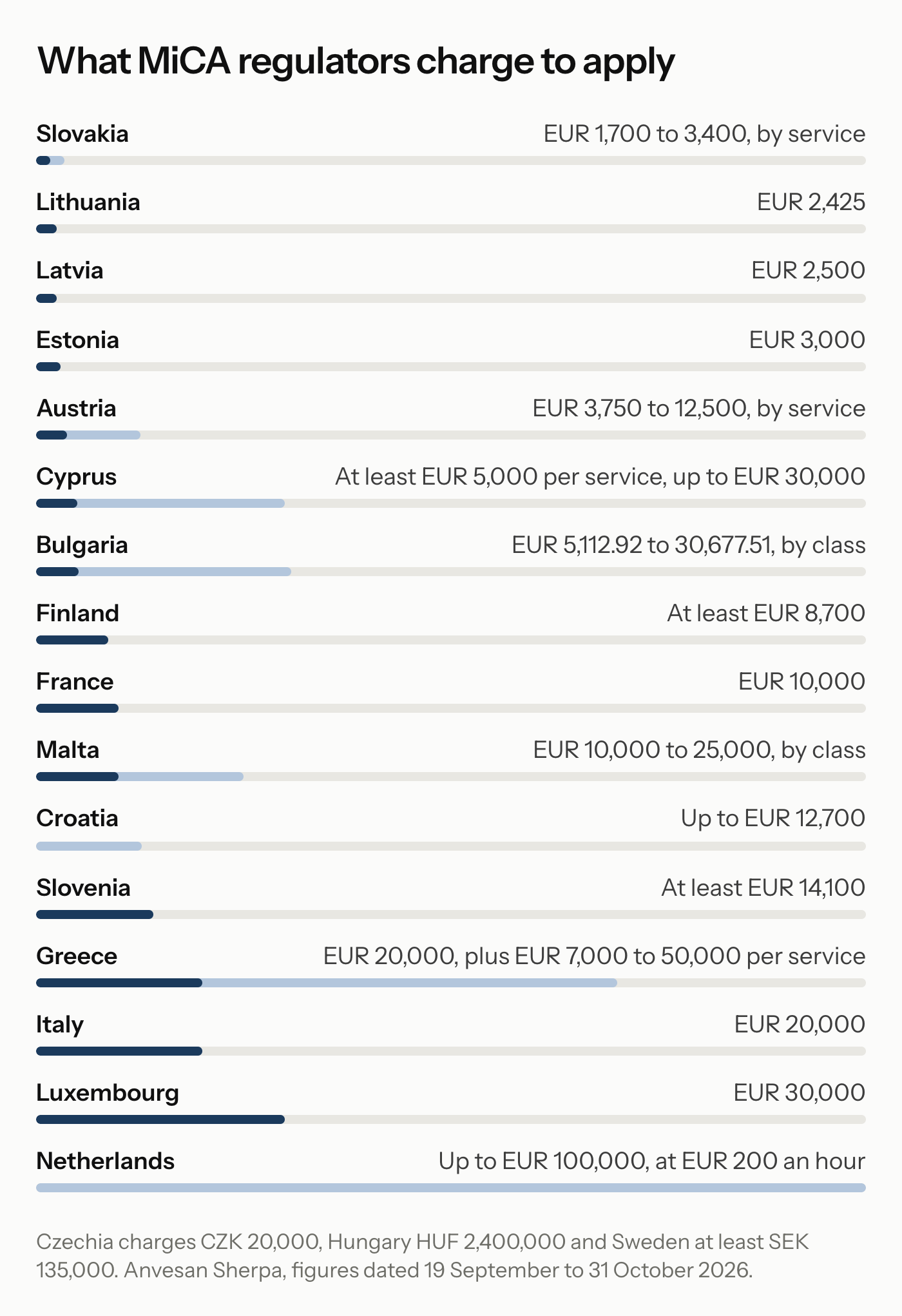
An Austrian law firm puts legal fees at about EUR 300,000 for a company with an established business and working KYC processes. One Maltese advisory firm estimates EUR 300,000 to 400,000 to obtain a licence and run it for the first year. The report has no practitioner estimate for the UK.
How long each takes
In law, the FCA has six months from a complete application. MiCA gives a regulator 40 working days from a complete application.
Under MiCA, practice can run longer. An Austrian law firm says to expect 10 to 12 months, and two Liechtenstein law firms estimate 6 to 12 months. These are estimates, and they vary with the firm and the business.
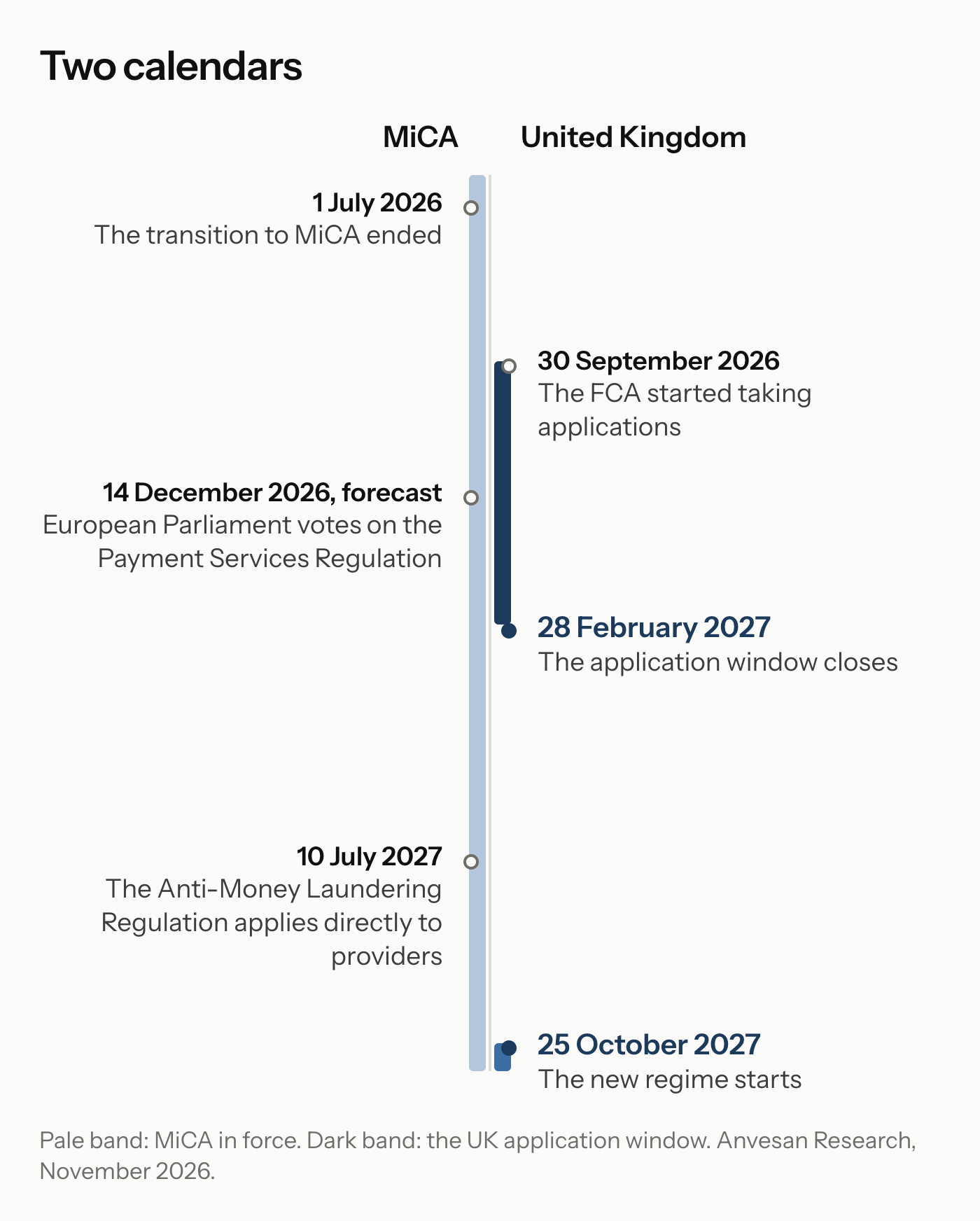
The UK date to plan around is 28 February 2027. An existing firm that applies after it may have to stop its crypto activities when the new regime starts. A registration under the money laundering rules does not carry over, so a registered firm still needs authorisation.
The FCA is also consulting on guidance for new exclusions from the regime, with comments due by 18 November 2026.
Under MiCA, the transition ended on 1 July 2026, and the EU's securities markets authority, ESMA, expects firms without MiCA authorisation to wind down their EU business.
Wallets and transfers
Under MiCA, a stablecoin wallet or transfer business usually needs a second licence. EU banking guidance treats moving stablecoins for customers, and wallets that send and receive them, as payment services. In Austria and Malta, a firm needs a payment institution licence for this, unless it partners with a licensed payment provider. Exchange alone does not require it, and the payment licence applies only to stablecoins pegged to a single currency.
In Austria and Malta, that second licence takes EUR 125,000 of capital for most payment services. The European Parliament's vote on the Payment Services Regulation, forecast for 14 December 2026, may change when it is required.
In the UK, holding crypto for customers needs registration as a custodian wallet provider today, and authorisation to safeguard it from 25 October 2027. Transfers are not on the FCA's list of new regulated crypto activities. Payments in pounds and e-money need authorisation as a payment institution or an e-money institution.
Staff and local presence
Under the new UK regime, most crypto firms come under the Senior Managers and Certification Regime, so senior roles need the FCA's approval, and under the Consumer Duty. Today's registration requires a money laundering reporting officer, and the FCA expects that person to know UK regulation and crypto assets.
The report notes that MiCA requires an EU-resident director. Local presence then differs by country:
- Austria: the report says at least five dedicated people. A payment or e-money licence also needs a managing director who lives in Austria and speaks German.
- Malta: at least two people directing the business, with at least one executive director based in Malta.
- Liechtenstein: the report puts the minimum local team at four, and in practice the regulator expects staff to live within about 100 kilometres of Vaduz.
Issuing a stablecoin
Both regimes require redemption at par or face value and limit what holders can earn, but the details differ.
| United Kingdom | MiCA | |
|---|---|---|
| Who may issue | A firm with FCA authorisation to issue a qualifying stablecoin | A bank or a licensed e-money institution, for a coin pegged to a single currency |
| Minimum capital | £350,000 | At least EUR 350,000 initial capital for an e-money institution |
| Holding the funds | Coins backed one to one, mainly with short-term deposits and short-term government debt, on a statutory trust | At least 30% of the funds received held in separate bank accounts. The report gives no other split |
| Redemption | At par, by the end of the business day after receiving the coin | At face value, at any time |
| Interest | May not pass the interest on its backing assets to holders | Must not pay holders interest |
| Also | The Bank of England, alongside the FCA, if the Treasury designates a sterling stablecoin as systemic | White paper notified to the regulator and published |
Which to start with
These questions help set the order.
Where are your customers? Each regime covers its own market, so this comes first.
Do you already operate in the UK? If so, the UK window is the fixed date, whatever else you plan.
Do you deal as principal? At £750,000, UK capital for dealing as principal is the largest figure in either regime's ladder. The FCA is consulting on guidance for a draft exclusion covering proprietary trading where a firm provides no service to another person.
For the service you plan to offer, see today's UK registration path or a MiCA country's path in Sherpa's Pathfinder, free with an account.
This guide is planning information from official sources and practitioner estimates, not legal advice. Confirm the details with a law firm in each country before you file.