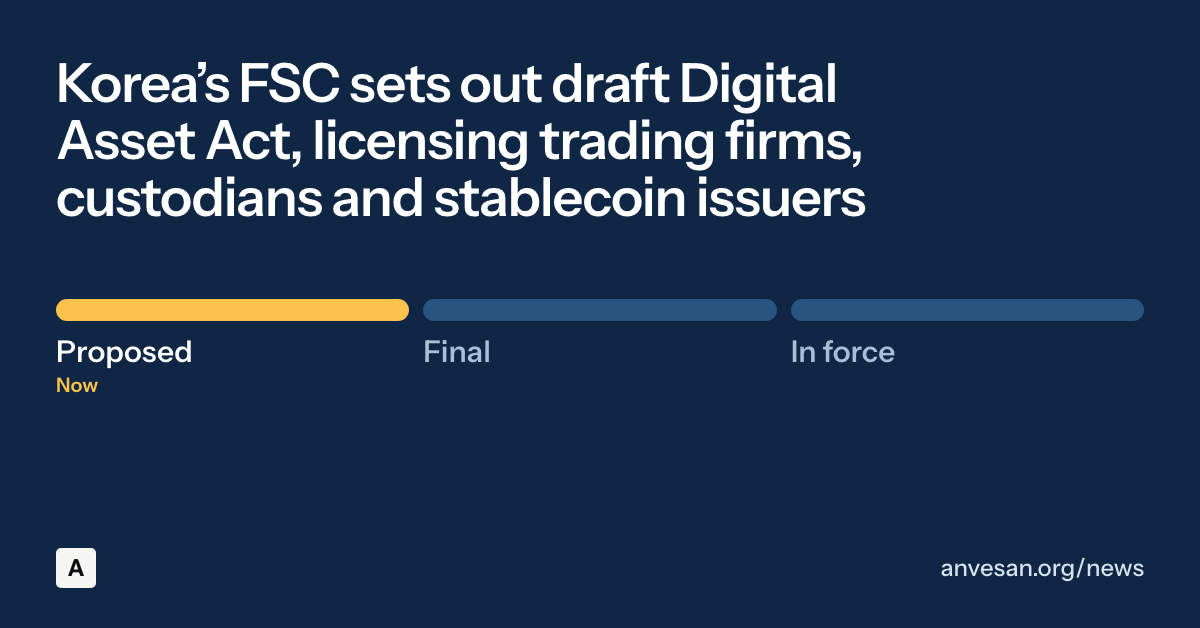
Korea's FSC sets out draft Digital Asset Act, licensing trading firms, custodians and stablecoin issuers
The government draft would require stablecoin issuers to hold FSC authorisation and at least 5 billion won in capital; the FSC plans to let bank-majority consortia issue first.
Summary
- Government outlines draft bill; not law
- Dealing, brokerage and custody would need authorisation
- Stablecoin issuers: authorisation, at least 5 billion won capital
- Reserves of at least 100%, no interest to holders
- Bank-majority consortia planned as the first issuers
What happened
On 24 Nov 2026, South Korea's Financial Services Commission (FSC) published the main contents of the government's draft Act on Innovation in the Digital Asset Industry and User Protection. The FSC's Virtual Asset Committee discussed it the same day. The FSC said it will actively support the legislative process so that the National Assembly can enact the bill promptly after sufficient debate.
What changed
Nothing has changed in law yet. Korea now regulates virtual assets under two laws: one sets a reporting system and anti-money-laundering duties, the other covers user assets and unfair trading. The draft is the integrated law the government has pursued.
The draft splits the business into dealing, brokerage, custody and asset management firms, plus digital asset platform operators. Dealing, brokerage and custody would need authorisation, with capital set by presidential decree at 2 billion won or more, or 1 billion won or more for firms handling only stablecoins. Asset management would be registered. The FSC could designate a firm holding all three authorisations, and meeting further requirements, as a platform operator (an exchange). Shareholdings in an operator would be capped at 20%. The FSC plans to use the decree to allow up to 34% with its approval. The cap would be deferred for 3 years after designation, with up to 3 more years for small and mid-sized exchanges.
The draft calls stablecoins "digital payment tokens": digital assets that aim to hold a stable value by reference to one currency and are used mainly for payment. An issuer would need FSC authorisation, capital of at least 5 billion won and an approved issuance plan. Tokens could pay no interest. Issuers would have to redeem without delay at the same value in money, and deposit or entrust at least 100% of the outstanding amount with reserve managers such as banks. The FSC plans to allow issuance first by consortia in which banks hold a majority, with fintech and technology firms able to be the largest shareholder. The FSC could designate significant tokens from those with 1 trillion won or more outstanding, and the Bank of Korea could request joint inspections of their issuers.
Who is affected
Firms that deal, broker or hold digital assets, and exchanges; banks and fintech firms planning a stablecoin; foreign issuers sufficiently supervised at home, which could issue through a Korean branch registered with the FSC after filing each token with the FSC; and token issuers selling to the public in Korea, who would file a white paper with the FSC first.
What happens next
The bill needs the National Assembly to enact it. Lawmakers have already introduced 12 bills of their own on the subject, according to the FSC. The FSC gave no date for submission, enactment or the law taking effect. The English wording is Anvesan's translation.
Anvesan view
The draft would replace Korea's single reporting regime for virtual asset service providers with authorisation for dealing, brokerage and custody, registration for asset management and FSC designation for exchanges. The bank-majority start for issuers is left to the decree.
Official source
Source: Financial Services Commission (FSC), press release, published 24 Nov 2026.
Published