All 28 registered Korean virtual asset providers filed under the amended Act; KoFIU and FSS begin review
KoFIU and the FSS will review major shareholders for the first time, and refusal under the debt ratio and compliance tests starts a year after the Act took effect.
Summary
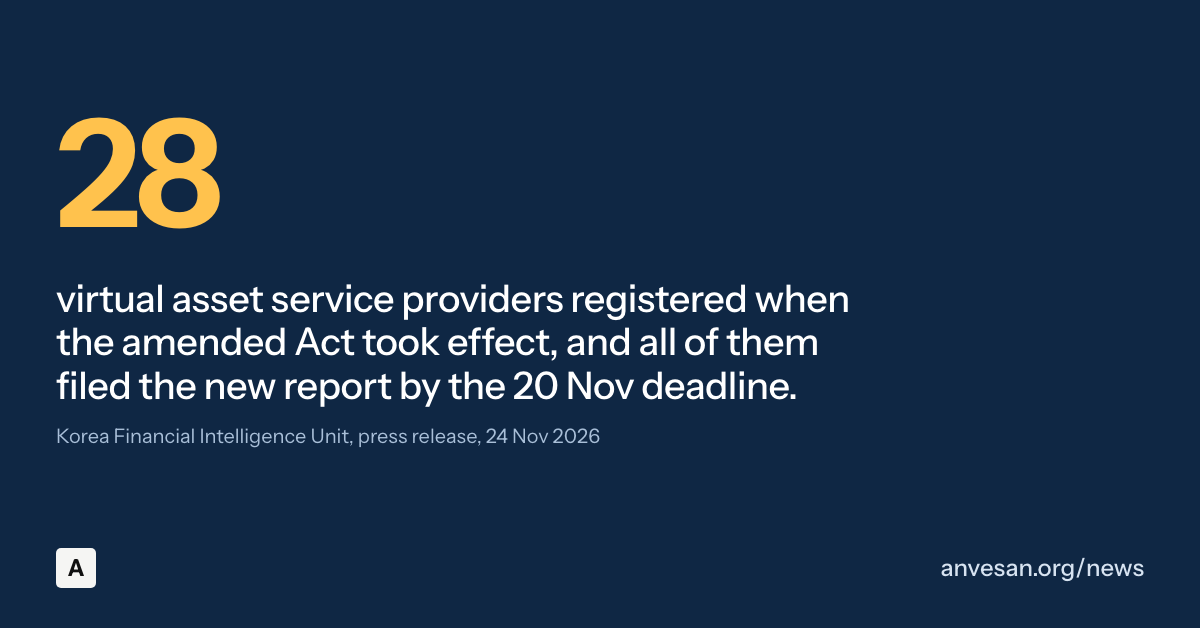
- All 28 registered providers filed by the 20 Nov deadline
- Review now covers major shareholders for the first time
- Filing does not extend a registration's three-year validity
- Debt ratio, compliance refusal grounds deferred one year
- Review began 23 Nov, with on-site checks where needed
What happened
On 24 Nov 2026, the Korea Financial Intelligence Unit (KoFIU) and the Financial Supervisory Service (FSS) said that all 28 virtual asset service providers registered when the amended Act on Reporting and Using Specified Financial Transaction Information took effect had filed a new report under the Act's transitional provisions within the deadline. The 28 are 5 won-market exchanges, 13 coin-market exchanges and 10 wallet, custody and other providers.
What changed
The amended Act is in force. It took effect on 20 Aug, and existing providers had until 20 Nov, both in 2026, to report under the amended provisions. The Act widened review beyond the provider, its representative and officers to its major shareholders. It also added refusal grounds on financial condition, social credit and the compliance system, including organisation, staff, IT systems and internal controls. Major shareholders include the largest shareholder, holders of 10% or more, shareholders with de facto influence over management, shareholders who are related parties of the largest shareholder, and, where the largest shareholder is a company, that company's own largest shareholder and representative.
KoFIU and the FSS set out how the one-time filing works. Acceptance does not extend a registration's validity, which runs three years from the original registration's acceptance. Providers must still file a renewal at least 45 days before expiry, or the registration lapses at expiry. A change in major shareholders or officers after filing needs a separate change report. For this filing, fines or defaults of existing major shareholders from before the Act took effect are not grounds for refusal, because the earlier rules apply to an existing representative, officer or major shareholder until that person changes. They must still be reported, and a false entry or a material omission can itself be a ground for refusal.
Who is affected
The 28 registered virtual asset service providers in South Korea, their representatives and officers, and their major shareholders.
What happens next
KoFIU and the FSS planned to begin reviewing all filings from 23 Nov. They may check IT systems and internal controls on site, including whether the controls work. Final notices may arrive at different times for each provider, and the release says the order does not indicate eligibility or ranking.
The debt ratio requirement (200% or less) and the compliance system requirements, which include at least four AML staff and a qualified compliance officer, are deferred for one year. For providers registered before the Act took effect, refusal and cancellation under these requirements apply from 20 Aug of the following year, one year after the amended rules took effect. A provider that still falls short after the grace period can be subject to cancellation. KoFIU and the FSS plan to take improvement plans from providers that fall short and keep checking progress.
Anvesan view
This review is the first in which KoFIU and the FSS test the major shareholders of Korea's 28 registered virtual asset service providers, and from one year after the Act took effect, debt ratio and compliance system gaps can lead to cancellation. The English wording is Anvesan's translation.
Official source
Source: Korea Financial Intelligence Unit (KoFIU), press release, published 24 Nov 2026.
Published